
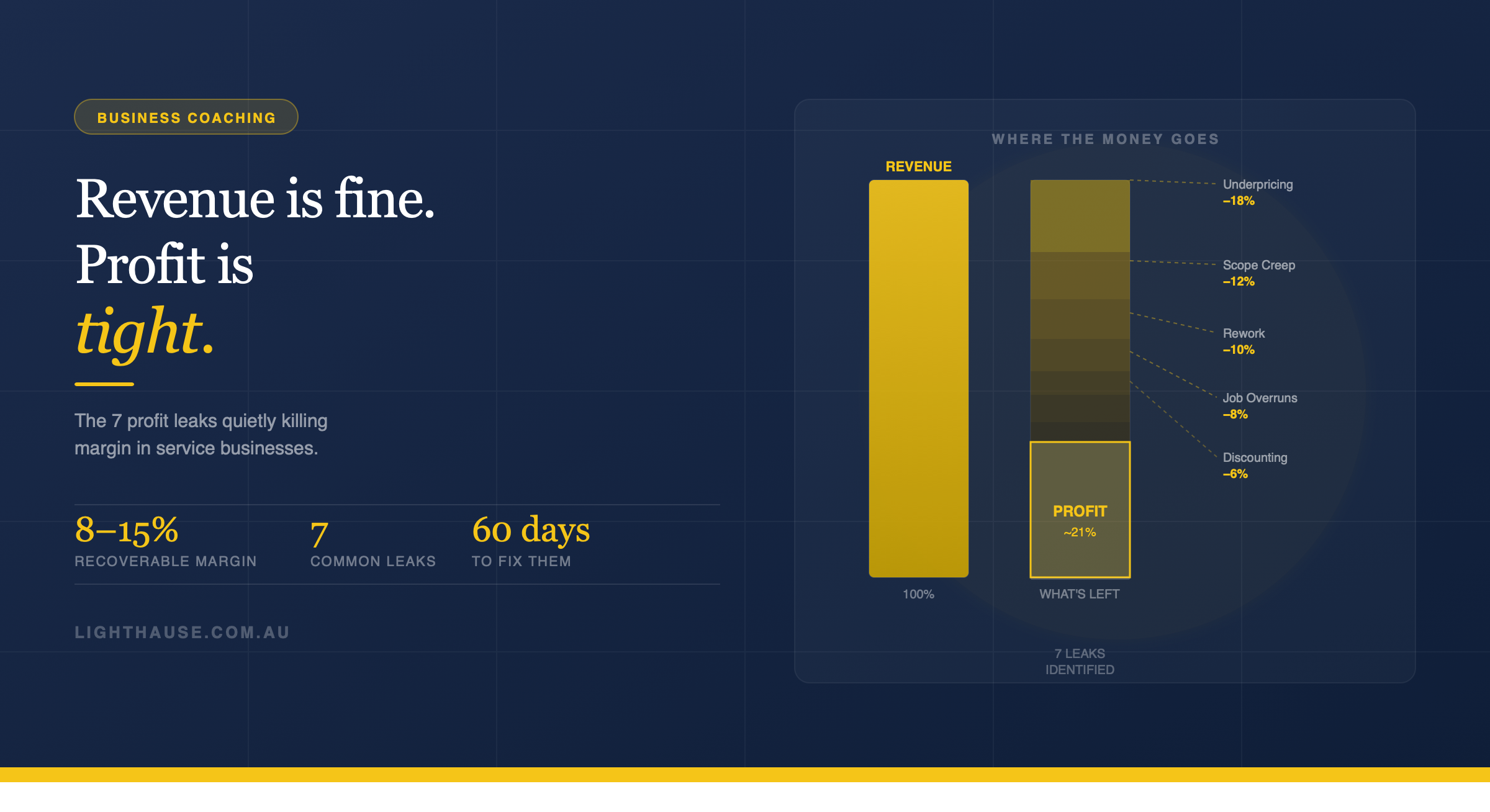
Revenue is Fine But Profit is Tight: The 7 Profit Leaks Quietly Killing Margin in Service Businesses
Revenue looks fine but profit’s still tight? This guide breaks down the 7 profit leaks quietly killing margin in service businesses and the practical fixes that recover profit in 30–90 days.
Most service business owners know their revenue number. Very few actually know their margin. And the gap between the two — the money that disappears between invoicing and paying yourself — is almost always explained by the same seven problems.
This isn't about working harder or winning more clients. You might already be doing both. The issue is structural: there are specific, fixable leaks in your business that are quietly consuming the profit that should be landing in your account.
This is business coaching for service business owners focused on increasing profit, tightening margin, and removing the operational leaks that keep profit tight even when revenue is fine.
Here's what they are, how to find yours, and what to do about them.
First: Why Profit Problems Feel Like Revenue Problems
When margin is tight, the instinctive response is to go get more work. More clients, more jobs, more revenue. And that works — until it doesn't.
The problem is that if your margin is 12% and you want to take home an extra $100K, you need to win an extra $830K in revenue to get there. That's a massive amount of sales effort to compensate for what is, in reality, a structural problem.
Fix the leaks first. The same revenue base produces significantly more profit when the margin problems are resolved. Most service businesses we work with find 8 to 15 percentage points of recoverable margin — money they're already earning, that's just disappearing before it reaches the bottom line.
"Revenue looks decent. But somewhere between 'just do it for them,' rework, and jobs that take longer than we priced — it's hard not to feel ripped off by my own business."
That feeling is diagnostic. It tells you the leaks exist. The job is finding exactly where they are.
The 7 Profit Leaks in Service Businesses
LEAK 01
Underpricing — and Not Knowing It
Most service business owners set their prices years ago, when they needed work, when they were less experienced, or when they were nervous about losing clients to cheaper competitors. Those prices rarely get reviewed. Meanwhile, your costs have gone up, your team has grown, and your value has increased — but your rates haven't kept pace.
Underpricing is the most common profit leak in service businesses and the hardest one to see clearly, because the revenue still looks reasonable. The jobs are coming in. The invoices are going out. But the gap between what you're charging and what it actually costs you to deliver is slowly eating you alive.
The fix starts with a proper cost-to-deliver analysis for every service type you sell. What does it actually cost — in labour, overhead allocation, and time — to deliver this work? Once you know that number, the right price becomes obvious. Most owners who do this exercise discover they need to increase rates by 15 to 30% on at least some of their service lines.
LEAK 02
Scope Creep That Nobody Is Tracking
You quoted the job. The client asked for a few extras along the way. Your team just did them — because it seemed easier than having the conversation. The invoice went out for the original scope. The job cost 40% more to deliver.
Scope creep is the silent margin killer in almost every service business. It happens at the job level, it's almost never tracked systematically, and it compounds quietly until you've essentially done a significant percentage of your work for free.
The structural fix is a clear change-order process: any work outside the original scope gets flagged, priced, and approved before it's done. Not after. This requires your team to understand the scope boundaries and have the confidence to have the conversation with clients. That's a training and authority problem as much as a process problem — and it's worth solving properly.
LEAK 03
Rework That Eats Time and Gets Absorbed
Jobs that need to be redone, fixed, or revisited after delivery are pure margin destruction. You've already invoiced. The rework cost comes entirely out of profit. And in most businesses, it isn't even tracked — it just gets absorbed into the chaos of delivery and never shows up as a discrete cost.
The cause of most rework is upstream: unclear briefs, rushed handoffs, poor job specifications, or insufficient quality checks before delivery. The fix isn't working harder at the rework stage — it's building the systems that prevent the rework from happening in the first place.
Start by tracking rework hours for 60 days. The number will surprise you. Then trace each instance back to its root cause. You'll find the same two or three failure points responsible for 80% of your rework — and fixing those has an outsized impact on margin.
LEAK 04
Jobs That Run Over Budget and Nobody Notices
You estimated 12 hours. The job took 19. You invoiced for 12. That's a 58% cost overrun on that job — absorbed with no visibility, no accountability, and no adjustment to future pricing. Multiply that across your job volume and the margin destruction is significant.
The issue in most businesses isn't that jobs run over — it's that there's no system to catch it when they do and no process to understand why. Actual vs. estimated hours needs to be tracked at the job level, reviewed regularly, and used to improve both your estimating and your delivery processes.
This data also tells you which job types are systematically mispriced — the categories where you consistently underestimate because the real delivery complexity has never been properly costed. That's pricing information you can act on immediately.
LEAK 05
Staff Time That Isn't Billable or Productive
If you have a team, a significant portion of their paid time is almost certainly not generating revenue. Administration, travel, waiting, internal meetings, fixing mistakes, doing work that's outside their role — it all costs you money while producing nothing you can invoice.
Most service businesses have no clear picture of what their team actually does with their time. They track hours on jobs (sometimes) but not the overhead that surrounds the jobs. Understanding your real utilisation rate — the percentage of paid time that's genuinely productive and billable — is one of the most revealing diagnostics you can run on your business.
In a healthy service business, utilisation sits at 65 to 75% for delivery staff. If yours is lower, the gap is your margin opportunity. Fixing it usually requires better job scheduling, clearer role boundaries, and honest conversations about how time is actually spent.
LEAK 06
Discounting That's Become a Habit
It started as a strategic decision — a discount to close a deal, keep a valued client, or win a job during a quiet period. But somewhere along the way it became the default. Your team quotes a number, the client pushes back, and the discount happens automatically without real consideration of the margin impact.
Discounting is one of the most margin-destructive habits in service businesses because the impact is disproportionate. A 10% discount on a 30% margin job doesn't reduce your profit by 10%. It reduces it by a third. Most owners don't think about it in those terms — and their teams certainly don't.
The fix is simple but requires discipline: set a discount approval threshold and stick to it. Discounts above a certain level require your sign-off or a defined business reason. Track the discounts that happen. Review them. You'll quickly see whether they're genuinely strategic or just conflict avoidance.
LEAK 07
Overhead That Has Grown Unchecked
In a growing service business, overhead tends to accumulate quietly. Subscriptions added and forgotten. Staff headcount that outpaced revenue growth. Premises that made sense two years ago but are now oversized. Each individual cost feels manageable — but together they've raised your break-even significantly without a corresponding increase in revenue.
A proper overhead review — done once a year at minimum — almost always surfaces meaningful savings. Not dramatic cuts, but the kind of waste that creeps in when costs aren't scrutinised regularly: software nobody uses, suppliers who haven't been renegotiated, roles that have evolved beyond what's needed.
More importantly, understanding your overhead structure tells you what your minimum viable revenue is — the number below which the business loses money regardless of how hard you work. If that number has crept up without you noticing, your margin is under more pressure than your revenue growth has compensated for.
How to Find Your Biggest Leak
The Quick Diagnostic
Pull your last 12 months of revenue and net profit. What's your actual margin percentage?
Pick your three highest-volume job types. Do you know the real cost to deliver each one?
How many jobs in the last quarter ran over their estimated hours? By how much?
What percentage of your last 20 quotes included a discount? What was the average discount?
What did your rework cost you last month in labour hours?
What's your overhead as a percentage of revenue? Has it increased in the last 12 months?
You don't need to answer all of these immediately — but the ones you can't answer are usually pointing directly at your biggest leak. Uncertainty about your numbers is itself diagnostic information.
In most businesses, two or three of these seven leaks account for the majority of the margin problem. Fix those first. Don't try to tackle all seven simultaneously — it dilutes focus and slows everything down.
What Fixing the Leaks Actually Looks Like
The conversation about profit leaks is easy. The implementation is harder — not because the fixes are complex, but because they require behaviour change from you and your team, and behaviour change requires accountability.
Pricing reviews get deferred because raising prices feels risky. Change order processes get ignored because having the conversation with clients is uncomfortable. Rework tracking doesn't happen because nobody wants to surface the data. These are cultural and structural problems, not information problems.
The businesses that fix their margin fastest are the ones with a forcing function: someone outside the business holding them accountable for the changes, helping them navigate the client conversations, and making sure the systems actually get built and used — not just discussed and forgotten.
"We identified the capacity constraints, fixed the pricing model, and built a referral system that brought in consistent work. Revenue doubled in 12 months." — Nathan, Crackers Clear Out
A 5 percentage point improvement in margin on a $1M revenue business is $50,000 in additional profit on the same revenue base. For most service businesses, that's achievable in a single quarter once the leaks are identified and addressed systematically.
Find out where your margin is going
Want help fixing margin properly?
If you’re doing $500k–$2m+ and profit feels tight, I’ll help you find the 2–3 real leaks in your business and build the pricing, change-order, and delivery systems to keep the profit you’re already earning.
Apply to work with Lighthause and I’ll get back to you within 24–48 hours.
What is a healthy profit margin for a service business?
It varies by industry, but as a general benchmark, service businesses should target net profit margins of 15 to 25%. Trades and construction businesses often run lower (10 to 18%) due to material and labour costs. Professional services and consulting businesses can run higher (20 to 35%). If you're consistently below 10% net margin, you almost certainly have one or more of the seven leaks operating in your business.
How do I know if I'm underpricing my services?
The clearest signal is that you're winning most of your quotes. A win rate above 70 to 75% usually means you're leaving money on the table — your prices are low enough that clients say yes too easily. Other signals include consistently tight cash flow despite reasonable revenue, clients who never push back on price, and the inability to remember the last time you raised your rates.
How do I stop scope creep without damaging client relationships?
The key is having the conversation early and framing it as professionalism, not inflexibility. "That's outside what we quoted — I'll get you a price for it before we proceed" is a statement that most clients respect. Clients who push back on change orders are often the same clients who generate the most rework and the most margin problems. A clear change order process actually builds trust with good clients, because it demonstrates that you manage your work precisely.
Should I raise prices even if I'm worried about losing clients?
Almost certainly yes — but do it strategically. Start with new clients and new quotes. Review your client list and identify the 20% of clients who generate the most problems, demand the most discounts, or produce the most rework. These are the clients most worth losing. Raising prices often naturally filters them out, improving your overall margin even if volume drops slightly. For your best clients, a well-communicated price increase with adequate notice is rarely the threat it feels like.
How quickly can a business coach help improve profit margins?
Most clients working with Lighthause see measurable margin improvement within 60 to 90 days. The first step is always a clear diagnostic — identifying which two or three leaks are responsible for the bulk of the problem. From there, the fixes are structural: pricing frameworks, change order processes, rework tracking, overhead reviews. These can be implemented quickly when there's focus and accountability driving them.
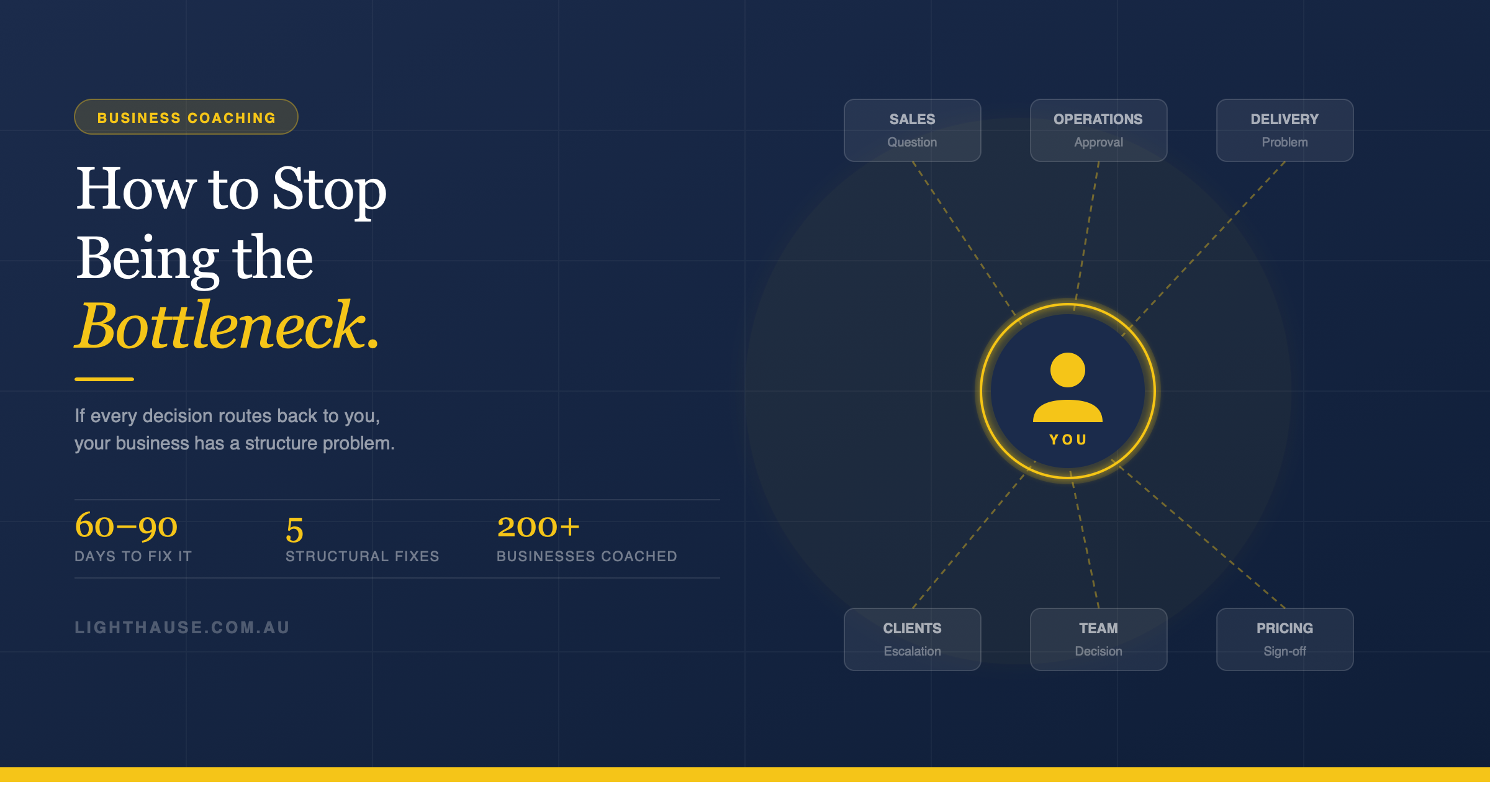
How to Stop Being the Bottleneck in Your Service Business
If your service business can’t move without you, you don’t have a team problem, you have a structure problem. This guide shows why owner dependency happens and the practical fixes that reduce it, so decisions get made, the team steps up, and the business stops bottlenecking through you.
If your business can't move without you — if decisions wait for your approval, problems route to your inbox, and you're the last checkpoint for everything — you don't have a team problem. You have a structure problem.
And it's one of the most common ceilings in service businesses doing $500K to $2M+.
You built the business. You know how everything works. You're the one clients trust, the one your team defaults to, the one who fixes things when they go sideways. That was fine when you were smaller. But now it's the thing stopping you from growing — and from stepping back.
This is business coaching for service business owners focused on reducing owner dependency, increasing profit, and building team accountability so the business can grow without everything depending on you.
This article breaks down exactly why owner dependency happens, how to diagnose your version of it, and the structural changes that actually fix it.
Why You Became the Bottleneck
It didn't happen because you hired badly or because your team is incapable. It happened because the business was built around you — your decisions, your standards, your relationships, your availability.
In the early days, that made sense. You were the product. Your judgment was the quality control. Your hustle was the pipeline.
But as the business grew, the structure didn't keep up. You added people without adding clarity. You gave them tasks without giving them authority. You stayed involved in everything because stepping back felt like losing control — and frankly, it was faster to just do it yourself.
"Nothing really moves until it comes back to me — pricing, expectations, approvals. Even with a team, I'm still the checkpoint everything routes through."
That's owner dependency. And left unchecked, it creates a hard ceiling on what the business can become.
The Real Cost of Being the Bottleneck
Most founders underestimate the compounding damage of staying in the middle of everything. Here's what it actually costs:
It caps your revenue
If your capacity is the constraint, revenue can only grow as fast as you can work. Every project, every decision, every client escalation that requires you means the business is limited to what one person can handle. You hit a number and bounce off it, year after year, wondering what's wrong.
It keeps you doing the wrong work
When you're the bottleneck, your days fill with reactive work — questions from your team, fires to put out, approvals to sign off. The strategic work, the growth work, the things only you can actually do — those get squeezed into nights and weekends, or don't happen at all.
It prevents your team from developing
People learn by making decisions and living with the consequences. If every decision routes back to you, your team never develops judgment. They stay dependent. You stay trapped. The cycle reinforces itself.
It makes the business unsellable
A business that requires the owner to function is worth significantly less than one that runs without them. If you ever want to exit, reduce your hours, or simply take a holiday without your phone, owner dependency is the single biggest obstacle.
How to Diagnose Your Bottleneck
Before you fix it, you need to understand exactly where you're sitting in the middle. Ask yourself these questions honestly:
What decisions does your team make without coming to you first?
What happens when you're unavailable for a day — does work continue or stall?
Are there any client relationships that exist primarily with you personally?
Does your team know what "good" looks like without asking you?
Are there recurring problems that keep coming back to you to solve?
The pattern you're looking for is: where does uncertainty default to you? That's where your bottleneck lives.
Most service business owners find they're the bottleneck in three specific places: pricing decisions, client escalations, and hiring/firing. These tend to be the areas where the owner's judgment feels irreplaceable — but they're also exactly where structural clarity can replace personal involvement.
The Five Structural Fixes That Actually Work
These aren't time management tips. They're structural changes — the kind that make it impossible for everything to route back to you, rather than just inconvenient.
1. Define decision authority explicitly
Your team defaults to you because they don't know what they're allowed to decide. The fix isn't telling them to "use their judgment" — it's giving them explicit decision authority by category.
Map out every type of decision that gets made in your business. Then assign each one to a role: who owns this decision, who gets consulted, and who gets informed after the fact. When someone comes to you with a question that falls in their authority zone, redirect them: "That's your call. What are you going to do?"
Do this once, document it, and your team's dependency on you for routine decisions drops significantly within 30 days.
2. Define "what good looks like" for every key role
Your team bounces work back to you because they're not confident their output will meet your standard. They've been burned before — you've redone their work, or given feedback that felt unpredictable.
The solution is to make your standard explicit. For every key deliverable your business produces, write down what a good version looks like. Not a vague brief — a specific, observable description of done. When your team has that, they can self-assess before coming to you. Most of the time, they won't need to come to you at all.
3. Build a cadence that replaces ad-hoc check-ins
One of the biggest drivers of owner dependency is poor rhythm. When there's no regular meeting structure, your team fills the gap with individual interruptions — messages, questions, quick calls that fragment your day and keep you in the middle of everything.
Replace ad-hoc access with structured cadence: a weekly team meeting, a weekly 1:1 with each direct report, and a clear agenda format. When people know they'll get facetime on Thursday, they batch their questions instead of firing them at you as they arise. Your availability becomes predictable, and your reactive load drops.
4. Fix your pricing authority problem
In most service businesses, pricing is one of the last decisions owners give up. And understandably — bad pricing decisions are expensive. But if every quote requires your review, you're creating a delay in your sales process and a dependency that will never go away.
The fix is to build a pricing framework that your team can apply consistently: job categories, day rates, scope triggers, and escalation thresholds. Define the rules once. Train your team to apply them. Reserve your involvement for the edge cases — large jobs, unusual scopes, sensitive clients — not every single quote.
5. Handle client relationships at the system level, not the personal level
If your best clients think of your business as you personally — if they call your mobile, expect you to be on every job, or would follow you if you left — that's a fragile business. You haven't built a company. You've built a personal services practice.
The transition is uncomfortable but necessary. Start introducing your team as the point of contact for operational matters. Let them handle the day-to-day relationship. You stay involved at the strategic and relationship level — but the business relationship should be with your company, not with you personally.
What to Expect When You Start Letting Go
Be honest with yourself: the first few months of reducing your involvement will feel worse before it feels better.
Your team will make decisions you wouldn't have made. Some clients will notice the change and comment on it. Things will slip through the cracks that you would have caught. This is normal — and it's the cost of building a business that can function without you.
The alternative is staying exactly where you are: capable, competent, and completely trapped by your own business.
"The business grew because he stopped being the ceiling."
Most owners who commit to this process start seeing real change within 60 to 90 days. Not perfection — but a business that moves without them being in the middle of everything. Decisions getting made. Problems getting solved. And a calendar that finally has room for the work that actually grows the business.
When to Get Help
These structural changes are straightforward in principle. In practice, most owners find they need a forcing function — someone outside the business who can see the pattern clearly, hold them accountable for the changes, and help them navigate the discomfort of letting go.
If you've been aware of your bottleneck problem for more than six months and haven't fixed it, that's a signal. The issue isn't awareness — it's structure, accountability, and having the right support to make the changes stick.
Business coaching for service businesses isn't about motivation or frameworks you won't implement. It's about identifying the exact structural constraints in your business and fixing them — the accountability framework, the decision authority, the pricing clarity — so the business can grow without you carrying it.
Find out what's actually holding your business back
Want help fixing this in your business?
If you’re doing $500k–$2m+ and you’re still the bottleneck, I’ll help you map the exact points where everything routes back to you and build the decision authority, cadence, and pricing framework to fix it.
Apply to work with Lighthause and I’ll get back to you within 24–48 hours.
Frequently Asked Questions
How long does it take to reduce owner dependency in a service business?
Most owners see meaningful change within 60 to 90 days when they make structural changes — not just mindset shifts. Decision authority frameworks, defined standards, and meeting cadence can be implemented quickly. The harder part is maintaining the discipline not to revert when things go wrong.
What's the difference between being involved and being the bottleneck?
Being involved means you're engaged at the strategic level — setting direction, developing your team, handling the relationships and decisions that genuinely require your judgment. Being the bottleneck means routine operational decisions, client questions, and day-to-day problems can't move without you. One is leadership. The other is dependency.
Can a small team of 3–5 people operate without the owner being in the middle?
Yes — and it's actually easier with a small team than a large one. With 3–5 people, one clear decision authority framework and a weekly meeting rhythm is often enough to significantly reduce owner involvement. The key is making the standards and authorities explicit, rather than relying on the owner to fill the gaps.
Is owner dependency a sign of a bad team?
Rarely. In most cases it's a sign of a business that was built around the owner rather than built to run without them. The team is often more capable than the owner gives them credit for — they just haven't been given the authority, clarity, or confidence to operate independently. That's a structural problem, not a people problem.
What type of business coaching helps with owner dependency?
Business coaching for service business owners that focuses on structural change — accountability frameworks, decision authority, team operating rhythms — rather than generic goal-setting or motivation. Look for a coach who has actually scaled a service business, not just coached others to do so.