
How to Reduce Owner Dependency in a Service Business | Lighthause
If every decision still comes back to you, you’ve got owner dependency. This guide explains why it happens and the framework that helps your team make decisions without you, so the business stops relying on the owner for everything.
You built a team so you could work less in the business. Instead, you're managing more. Every decision still comes back to you. Every problem still ends up on your plate. The team is there — but somehow, you're still the one running everything.
This is owner dependency. And it's one of the most frustrating positions a service business owner can find themselves in — because the solution seems obvious (just let your team do more) but the reality of actually making that happen is far harder than it looks.
This is business coaching for service business owners focused on reducing owner dependency, improving team accountability, and building a business that doesn’t bottleneck through the owner.
This article explains exactly why owner dependency persists even when owners genuinely want to step back — and lays out the structural framework that actually fixes it.
Why Owner Dependency Isn't a People Problem
The instinctive explanation for owner dependency is a team problem. Your people aren't capable enough. They don't take initiative. They need too much direction. If you just had better people, this wouldn't happen.
That explanation is almost always wrong.
In most cases, the team is more capable than the owner believes — but they're operating inside a structure that makes independent decision-making impossible or unsafe. They default to the owner not because they can't think for themselves, but because the system around them rewards deference and punishes independent action.
"I'm paying for help and still carrying the responsibility. Every hire added more to watch, fix, or redo — not less."
Think about what your team actually experiences day to day. They make a decision. You reverse it. Or you redo it. Or you give feedback that implies they should have checked with you first. Over time, the rational response to that environment isn't to develop more confidence and judgment — it's to ask before acting. You trained them to be dependent, even if you never intended to.
Owner dependency is a structural problem. The structure of your business — how decisions get made, how authority is distributed, how performance is defined — creates the dependency. Change the structure, and the behaviour changes with it.
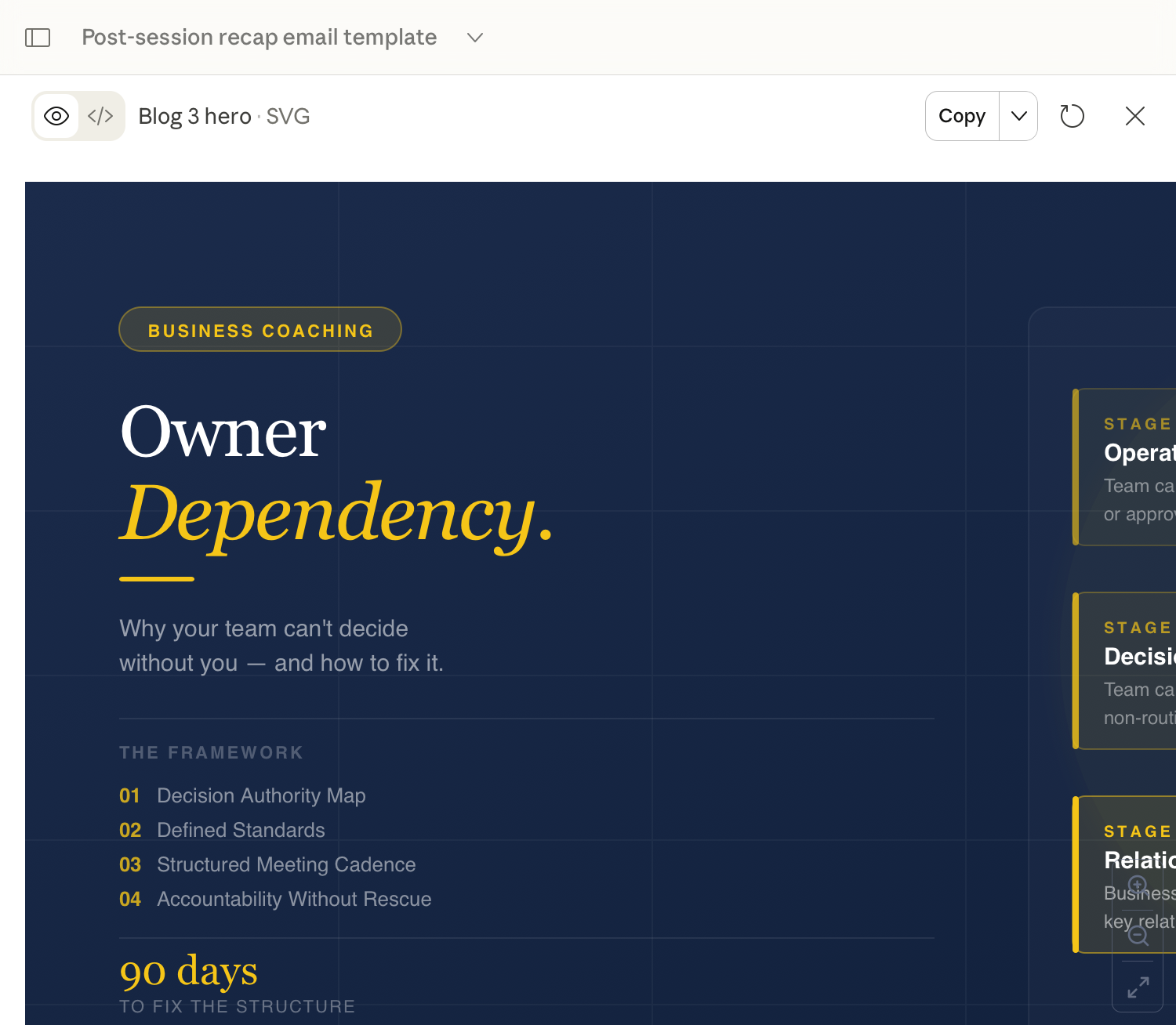
The Three Stages of Owner Dependency
Not all owner dependency looks the same. Understanding which stage you're in helps identify the right fix.
STAGE 01
Operational Dependency
Your team can't execute without your involvement. They need instructions, approvals, or oversight on day-to-day tasks — quoting, scheduling, client communication, delivery. You're functioning as a manager and doer simultaneously, and your capacity is the hard ceiling on output.
STAGE 02
Decision Dependency
Your team can execute tasks but can't make decisions. They can do the work but can't say yes to a variation, handle a difficult client conversation, or resolve a problem without escalating to you. You're not running the day-to-day work, but you're still the decision-maker for anything outside routine.
STAGE 03
Relationship Dependency
Your team can execute and make operational decisions, but your key client and supplier relationships sit with you personally. The business runs — until a major client calls, a key supplier negotiation arises, or a high-stakes problem emerges. At that point, everything still routes back to you.
Most businesses dealing with owner dependency are sitting somewhere between Stage 1 and Stage 2. Stage 3 is actually a relatively healthy problem to have — it means the operational structure is working. Getting from Stage 1 or 2 to Stage 3 is where the real work is.
Why Fixing It Is Harder Than It Looks
Every owner who struggles with dependency has tried some version of "just letting go." It didn't work. Here's why.
You haven't defined what good looks like
Your team can't meet a standard you haven't articulated. You have a clear picture in your head of what quality output looks like, how client conversations should be handled, what an acceptable decision looks like. Your team doesn't have that picture. They're guessing — and when they guess wrong, they get corrected, which reinforces the instinct to ask rather than act.
Authority is ambiguous
There's a difference between telling someone they're responsible for something and actually giving them the authority to make decisions about it. Most owners say they want their team to own their areas. But when the team acts on that ownership, the owner steps in — with a different view, a better idea, or a correction. The message received isn't "you own this." It's "you own this until I disagree."
There's no safety net for mistakes
In a well-structured business, people learn by making decisions and experiencing consequences. In an owner-dependent business, the owner is the safety net — they catch everything before it fails. This feels responsible. In practice, it prevents your team from ever developing the judgment and confidence that comes from real accountability. They stay junior. You stay busy.
The owner is still the hero
In many owner-dependent businesses, the owner's involvement is actually rewarded by clients. Clients like dealing with the founder. They trust the owner more than the team. The owner's involvement in solving problems generates client satisfaction. This feels good — and it is genuinely valuable. But if it prevents the business from ever running without the owner, it's a liability that will cap growth indefinitely.
The Framework for Reducing Owner Dependency
These four elements, built in order, create a business that can operate and grow without the owner being in the middle of everything.
The Owner Dependency Framework
1
Decision Authority Map. Document every type of decision made in your business. Assign each one to a role: who decides, who is consulted, who is informed. Be explicit. "Use your judgment" is not authority — it's ambiguity. Real authority is "you can approve variations up to $2,000 without checking with me." Once documented, hold the line. When someone brings you a decision that sits in their authority zone, redirect them.
2
Defined Standards. For every key output your business produces — quotes, client communications, delivery quality, internal reporting — write down what good looks like. Not a vague brief. A specific, observable description that allows your team to self-assess before handing work up. When the standard is clear, your team can match it without asking. When it isn't, they'll always need your input.
3
Structured Meeting Cadence. One of the biggest drivers of owner dependency is unstructured access. If your team can reach you any time, they will — for things that could wait, for questions they could answer themselves, for reassurance they've come to rely on. Replace ad-hoc access with structured rhythm: weekly team meeting, weekly 1:1s, a clear format for raising issues. Predictable access reduces reactive access.
4
Accountability Without Rescue. The hardest part. When your team makes a decision that you wouldn't have made, resist the urge to step in. When something goes wrong that you could have prevented, let the consequence happen and debrief rather than catching it. This isn't negligence — it's the only way your team develops real judgment. Set the guardrails (the authority map and standards), then let people work within them without the safety net of your constant oversight.
What This Actually Looks Like in Practice
Jamie Montalto ran his fitness business as a solo operator for years before it started to grow. By the time he had 22 trainers across 14 gyms, he was still involved in every staffing decision, every client complaint, and every equipment purchase. The team was large but completely dependent.
"From a solo operator to 22 trainers, 14 gyms, and a 7-figure fitness business. The business grew because he stopped being the ceiling."
The structural changes that allowed Jamie to step out weren't complicated. A clear hierarchy of decision-making by gym manager. A defined standard for trainer onboarding and client experience. A weekly ops meeting where issues got raised and resolved without him. And a deliberate period of non-intervention — letting the managers handle situations he would previously have owned.
Within 90 days, day-to-day operations were running without him. Within six months, he was working on the business — new locations, new partnerships, the growth work he'd been putting off for years — instead of in it.
That's the arc. It's uncomfortable in the middle. It produces a fundamentally different business at the end.
The Owner's Role After Dependency Is Resolved
A common fear is that reducing owner dependency means becoming irrelevant. It doesn't. It means changing what you're relevant for.
Before: You're involved in delivery, decisions, client escalations, team management, and the day-to-day operational running of the business. You're essential everywhere and therefore strategic nowhere.
After: You're involved in strategy, key relationships, growth decisions, and the development of your leadership team. You're essential where only you can add value — and liberated from everything else.
The businesses that grow past $2M, $5M, and beyond aren't run by founders who are essential to operations. They're run by founders who built structures that don't require them — and then focused their energy on the things that genuinely move the needle.
That transition doesn't happen automatically. It requires deliberate structural work, real accountability, and usually a period of genuine discomfort. But the alternative — staying indispensable in a business that can't grow past your own capacity — is a worse outcome.
Ready to build a business that runs without you?
Want help fixing owner dependency properly?
If you’re doing $500k–$2m+ and your team still can’t move without you, I’ll help you map decision authority, set clear standards, and build the rhythms that make the business run without you being the middleman.
Apply to work with Lighthause and I’ll get back to you within 24–48 hours.
Frequently Asked Questions
How do I reduce owner dependency without losing quality control?
The key is building quality into the system rather than maintaining it personally. Defined standards, clear checklists, and structured review processes mean quality gets maintained without your constant involvement. You shift from being the quality control to designing the quality control system. That's a more scalable and more reliable approach — because it doesn't depend on your availability.
What if my team genuinely isn't capable of operating without me?
In most cases, the capability exists but the structure doesn't support it. Before concluding you have a capability problem, ask whether you've given your team explicit authority, clear standards, and real accountability. Most owners who do this are surprised by how much their team can handle. If after genuinely testing this you still have a capability gap, that's a hiring and development problem — which is solvable, but different from a structural problem.
How long does it take to reduce owner dependency?
Most owners see meaningful change within 60 to 90 days when they implement structural changes deliberately. The first 30 days involves building the decision authority map and defining standards. Days 30 to 60 involve establishing the meeting cadence and beginning the non-intervention practice. By 90 days, most operational decisions are being made without the owner, and the pattern of deference starts to break down.
Is owner dependency worse in some industries than others?
It's particularly acute in trade businesses, professional services, and specialist firms where the owner's technical expertise is genuinely superior to the team's — and where clients specifically value working with the founder. The structural fixes are the same across industries, but the cultural work of transitioning client relationships away from the owner tends to take longer in these contexts.
What role does business coaching play in reducing owner dependency?
Business coaching for service business owners accelerates the process in two specific ways. First, an outside perspective can see the structural problems clearly — the owner is often too close to their own business to diagnose them accurately. Second, accountability from a coach provides the forcing function that most owners need to actually make the changes rather than defer them. Owner dependency is rarely solved by awareness alone. It's solved by structural change with accountability driving it.
How to Stop Being the Bottleneck in Your Service Business
If your service business can’t move without you, you don’t have a team problem, you have a structure problem. This guide shows why owner dependency happens and the practical fixes that reduce it, so decisions get made, the team steps up, and the business stops bottlenecking through you.
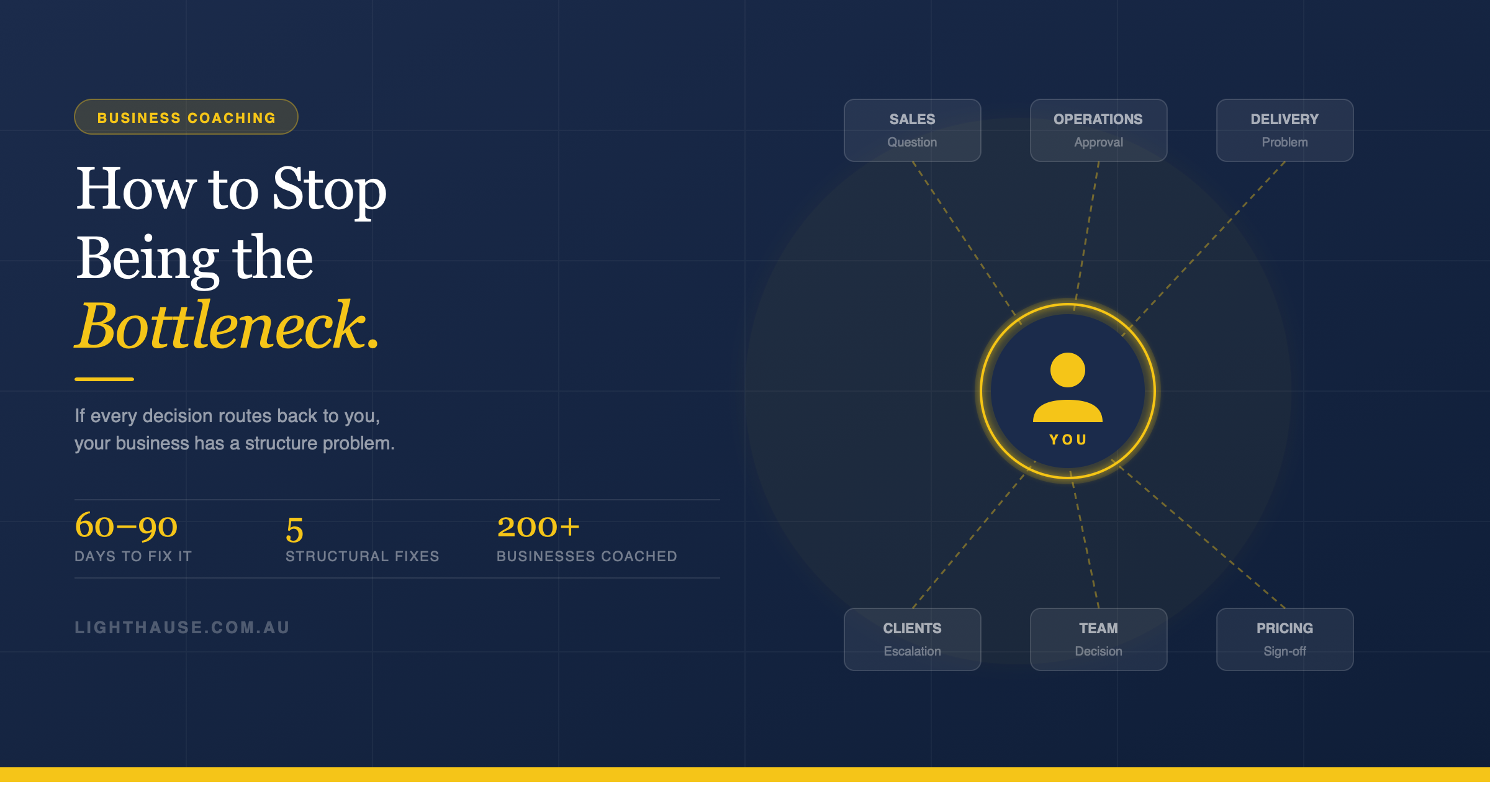
If your business can't move without you — if decisions wait for your approval, problems route to your inbox, and you're the last checkpoint for everything — you don't have a team problem. You have a structure problem.
And it's one of the most common ceilings in service businesses doing $500K to $2M+.
You built the business. You know how everything works. You're the one clients trust, the one your team defaults to, the one who fixes things when they go sideways. That was fine when you were smaller. But now it's the thing stopping you from growing — and from stepping back.
This is business coaching for service business owners focused on reducing owner dependency, increasing profit, and building team accountability so the business can grow without everything depending on you.
This article breaks down exactly why owner dependency happens, how to diagnose your version of it, and the structural changes that actually fix it.
Why You Became the Bottleneck
It didn't happen because you hired badly or because your team is incapable. It happened because the business was built around you — your decisions, your standards, your relationships, your availability.
In the early days, that made sense. You were the product. Your judgment was the quality control. Your hustle was the pipeline.
But as the business grew, the structure didn't keep up. You added people without adding clarity. You gave them tasks without giving them authority. You stayed involved in everything because stepping back felt like losing control — and frankly, it was faster to just do it yourself.
"Nothing really moves until it comes back to me — pricing, expectations, approvals. Even with a team, I'm still the checkpoint everything routes through."
That's owner dependency. And left unchecked, it creates a hard ceiling on what the business can become.
The Real Cost of Being the Bottleneck
Most founders underestimate the compounding damage of staying in the middle of everything. Here's what it actually costs:
It caps your revenue
If your capacity is the constraint, revenue can only grow as fast as you can work. Every project, every decision, every client escalation that requires you means the business is limited to what one person can handle. You hit a number and bounce off it, year after year, wondering what's wrong.
It keeps you doing the wrong work
When you're the bottleneck, your days fill with reactive work — questions from your team, fires to put out, approvals to sign off. The strategic work, the growth work, the things only you can actually do — those get squeezed into nights and weekends, or don't happen at all.
It prevents your team from developing
People learn by making decisions and living with the consequences. If every decision routes back to you, your team never develops judgment. They stay dependent. You stay trapped. The cycle reinforces itself.
It makes the business unsellable
A business that requires the owner to function is worth significantly less than one that runs without them. If you ever want to exit, reduce your hours, or simply take a holiday without your phone, owner dependency is the single biggest obstacle.
How to Diagnose Your Bottleneck
Before you fix it, you need to understand exactly where you're sitting in the middle. Ask yourself these questions honestly:
What decisions does your team make without coming to you first?
What happens when you're unavailable for a day — does work continue or stall?
Are there any client relationships that exist primarily with you personally?
Does your team know what "good" looks like without asking you?
Are there recurring problems that keep coming back to you to solve?
The pattern you're looking for is: where does uncertainty default to you? That's where your bottleneck lives.
Most service business owners find they're the bottleneck in three specific places: pricing decisions, client escalations, and hiring/firing. These tend to be the areas where the owner's judgment feels irreplaceable — but they're also exactly where structural clarity can replace personal involvement.
The Five Structural Fixes That Actually Work
These aren't time management tips. They're structural changes — the kind that make it impossible for everything to route back to you, rather than just inconvenient.
1. Define decision authority explicitly
Your team defaults to you because they don't know what they're allowed to decide. The fix isn't telling them to "use their judgment" — it's giving them explicit decision authority by category.
Map out every type of decision that gets made in your business. Then assign each one to a role: who owns this decision, who gets consulted, and who gets informed after the fact. When someone comes to you with a question that falls in their authority zone, redirect them: "That's your call. What are you going to do?"
Do this once, document it, and your team's dependency on you for routine decisions drops significantly within 30 days.
2. Define "what good looks like" for every key role
Your team bounces work back to you because they're not confident their output will meet your standard. They've been burned before — you've redone their work, or given feedback that felt unpredictable.
The solution is to make your standard explicit. For every key deliverable your business produces, write down what a good version looks like. Not a vague brief — a specific, observable description of done. When your team has that, they can self-assess before coming to you. Most of the time, they won't need to come to you at all.
3. Build a cadence that replaces ad-hoc check-ins
One of the biggest drivers of owner dependency is poor rhythm. When there's no regular meeting structure, your team fills the gap with individual interruptions — messages, questions, quick calls that fragment your day and keep you in the middle of everything.
Replace ad-hoc access with structured cadence: a weekly team meeting, a weekly 1:1 with each direct report, and a clear agenda format. When people know they'll get facetime on Thursday, they batch their questions instead of firing them at you as they arise. Your availability becomes predictable, and your reactive load drops.
4. Fix your pricing authority problem
In most service businesses, pricing is one of the last decisions owners give up. And understandably — bad pricing decisions are expensive. But if every quote requires your review, you're creating a delay in your sales process and a dependency that will never go away.
The fix is to build a pricing framework that your team can apply consistently: job categories, day rates, scope triggers, and escalation thresholds. Define the rules once. Train your team to apply them. Reserve your involvement for the edge cases — large jobs, unusual scopes, sensitive clients — not every single quote.
5. Handle client relationships at the system level, not the personal level
If your best clients think of your business as you personally — if they call your mobile, expect you to be on every job, or would follow you if you left — that's a fragile business. You haven't built a company. You've built a personal services practice.
The transition is uncomfortable but necessary. Start introducing your team as the point of contact for operational matters. Let them handle the day-to-day relationship. You stay involved at the strategic and relationship level — but the business relationship should be with your company, not with you personally.
What to Expect When You Start Letting Go
Be honest with yourself: the first few months of reducing your involvement will feel worse before it feels better.
Your team will make decisions you wouldn't have made. Some clients will notice the change and comment on it. Things will slip through the cracks that you would have caught. This is normal — and it's the cost of building a business that can function without you.
The alternative is staying exactly where you are: capable, competent, and completely trapped by your own business.
"The business grew because he stopped being the ceiling."
Most owners who commit to this process start seeing real change within 60 to 90 days. Not perfection — but a business that moves without them being in the middle of everything. Decisions getting made. Problems getting solved. And a calendar that finally has room for the work that actually grows the business.
When to Get Help
These structural changes are straightforward in principle. In practice, most owners find they need a forcing function — someone outside the business who can see the pattern clearly, hold them accountable for the changes, and help them navigate the discomfort of letting go.
If you've been aware of your bottleneck problem for more than six months and haven't fixed it, that's a signal. The issue isn't awareness — it's structure, accountability, and having the right support to make the changes stick.
Business coaching for service businesses isn't about motivation or frameworks you won't implement. It's about identifying the exact structural constraints in your business and fixing them — the accountability framework, the decision authority, the pricing clarity — so the business can grow without you carrying it.
Find out what's actually holding your business back
Want help fixing this in your business?
If you’re doing $500k–$2m+ and you’re still the bottleneck, I’ll help you map the exact points where everything routes back to you and build the decision authority, cadence, and pricing framework to fix it.
Apply to work with Lighthause and I’ll get back to you within 24–48 hours.
Frequently Asked Questions
How long does it take to reduce owner dependency in a service business?
Most owners see meaningful change within 60 to 90 days when they make structural changes — not just mindset shifts. Decision authority frameworks, defined standards, and meeting cadence can be implemented quickly. The harder part is maintaining the discipline not to revert when things go wrong.
What's the difference between being involved and being the bottleneck?
Being involved means you're engaged at the strategic level — setting direction, developing your team, handling the relationships and decisions that genuinely require your judgment. Being the bottleneck means routine operational decisions, client questions, and day-to-day problems can't move without you. One is leadership. The other is dependency.
Can a small team of 3–5 people operate without the owner being in the middle?
Yes — and it's actually easier with a small team than a large one. With 3–5 people, one clear decision authority framework and a weekly meeting rhythm is often enough to significantly reduce owner involvement. The key is making the standards and authorities explicit, rather than relying on the owner to fill the gaps.
Is owner dependency a sign of a bad team?
Rarely. In most cases it's a sign of a business that was built around the owner rather than built to run without them. The team is often more capable than the owner gives them credit for — they just haven't been given the authority, clarity, or confidence to operate independently. That's a structural problem, not a people problem.
What type of business coaching helps with owner dependency?
Business coaching for service business owners that focuses on structural change — accountability frameworks, decision authority, team operating rhythms — rather than generic goal-setting or motivation. Look for a coach who has actually scaled a service business, not just coached others to do so.