
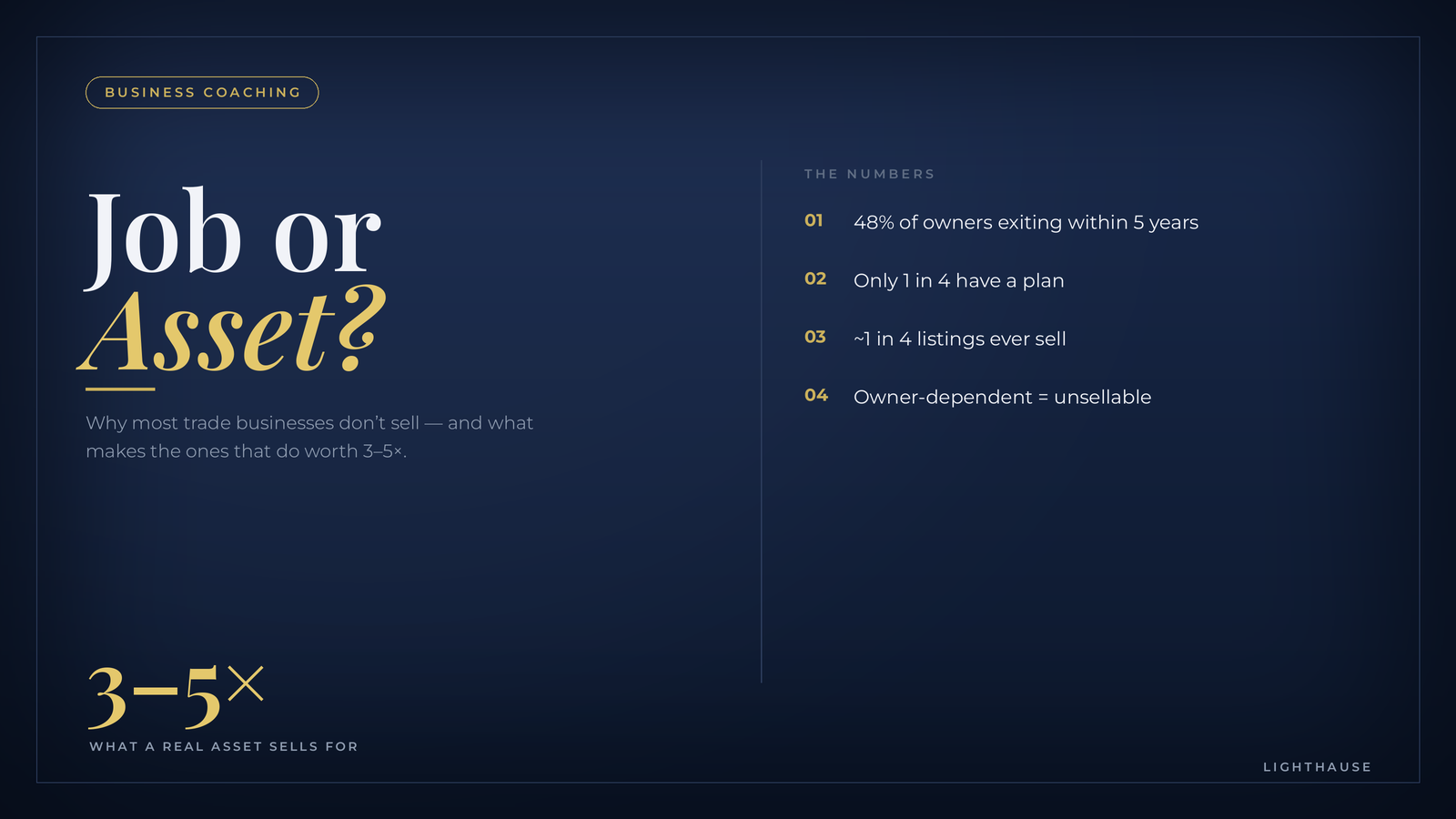
Why Your Trade Business Might Be Worth Less Without You Than You Think
Most trade business owners assume the years they've put in have built something worth selling. Many haven't, because the buyer isn't paying for what you've built. They're paying for what the business can do without you.
Most trade business owners assume the years they've put in have built something worth selling. Many haven't — because the buyer isn't paying for what you've built. They're paying for what the business can do without you.
You’ve spent fifteen, twenty, maybe thirty years building the business.
You’ve taken the calls after hours. Quoted the jobs. Solved the problems on site. Kept clients happy. Carried the team through the messy periods. Built the name, the reputation and the relationships.
And somewhere in the back of your mind, the business has probably become part of your retirement plan.
One day, you’ll sell it.
One day, all the years of risk, stress and hard work will turn into a number.
Then many owners finally speak to a broker or adviser and get a rude shock.
The business is worth less than they thought.
Sometimes a lot less.
And in some cases, the uncomfortable truth is that there may not be much to sell at all.
Not because the business is bad.
Not because the work isn’t good.
Not because the owner hasn’t worked hard enough.
Because the owner is still the business.
The problem most trade owners leave too late
Australia is heading into a major succession problem.
Family Business Association reporting has pointed to around $3.5 trillion in wealth expected to transition across Australian family businesses over the next 20 years, while only about 25% of Australian family businesses have a formal succession plan.
That matters because a lot of business owners are quietly relying on the sale of the business to fund the next stage of their life.
But there’s a gap between having a business that pays you well and having a business someone else will pay good money to buy.
That gap is usually owner-dependency.
If you own a trade business and you want it to be worth something one day, this is the work to start early.
Not the year you want to sell.
Years before.
Buyers don’t buy your past
This is the part many owners miss.
A buyer is not paying you for the years you spent building the business.
They’re buying future profit.
More specifically, they’re buying future profit they believe can continue after you leave.
That’s the issue.
If the future profit depends on you personally quoting the jobs, holding the client relationships, solving every site issue, managing the team, chasing the money and carrying thirty years of knowledge in your head, then the risk to the buyer is obvious.
The moment you leave, a big part of what they bought walks out the door with you.
No serious buyer pays a premium for that.
Many won’t want to buy it at all.
Why a busy trade business can still be a poor asset
Revenue alone does not make a business valuable.
A $5M trade business that depends completely on the owner can be a worse asset than a well-run $2M business with clean numbers, documented systems and a team that can operate without the founder.
That sounds harsh, but it’s how buyers think.
They’re asking:
Can this business win work without the owner?
Can it deliver work without the owner?
Are the margins real and visible?
Are the client relationships held by the business, or just by one person?
Is there a team that can make decisions?
Are the systems documented?
Can I trust the numbers?
If the answer is no, the business may still produce income while you’re there.
But it may not be a transferable asset.
That’s the difference.
A job pays you while you show up.
An asset keeps producing value when you’re not in the middle of it.
Owner-dependency is not just a lifestyle problem
Most people talk about owner-dependency like it’s only a time problem.
You’re tired.
You can’t take a holiday.
The phone never stops.
Everyone needs you.
That’s all true.
But it undersells the stakes.
Owner-dependency is also value destruction.
Every job only you can quote is risk a buyer will price in.
Every client who only wants to deal with you is risk.
Every undocumented process is risk.
Every margin that lives in your head instead of a report is risk.
Every team member who can’t make a decision without you is risk.
And risk pulls value down.
So this isn’t just about getting your evenings back.
It’s about whether the business you’ve spent decades building is actually worth something without you.
What separates a low-value business from a premium asset
The difference is usually structural.
A lower-value business tends to have the owner at the centre of everything.
The owner quotes the important jobs.
The owner holds the key client relationships.
The owner solves every messy issue.
The owner knows which jobs make money, but the numbers are not clearly reported.
The owner has systems, but they’re mostly in their head.
The owner has a team, but not a true management layer.
A stronger business looks different.
It has clean financials.
It has job costing.
It knows gross margin by job type.
It has documented quoting, pricing, scheduling and delivery processes.
It has a foreman, estimator, operations person or leadership layer that can make decisions.
It has clients who trust the company, not just the founder.
It has a weekly operating rhythm.
It has a pipeline, not just word of mouth and memory.
It has a business that can keep moving when the owner steps back.
That is what buyers pay for.
The most expensive sentence a trade owner can say
“If I’m honest, the business is me. If I stopped tomorrow, I’m not sure there’s much left to sell.”
That sentence costs more than most owners realise.
It costs you time now.
It costs you margin now.
It costs you control now.
And eventually, it can cost you the exit number you thought you were building towards.
The good news is that it is fixable.
The bad news is that it’s usually not fixable in the final six months before you sell.
You need time to reduce the dependency, clean up the numbers, build the team, document the systems and prove the business can run without you.
That’s why the smartest owners start years before they want out.
What the work actually looks like
Getting a trade business ready to sell is not about making a glossy brochure.
It’s not about a new logo.
It’s not about pretending the business is bigger than it is.
It’s operational.
It means making the business less dependent on you.
That usually means:
Getting quoting out of the owner’s head.
Building a simple sales pipeline.
Knowing which jobs actually make money.
Creating clear pricing rules.
Documenting how work is won, scheduled and delivered.
Building a management layer.
Moving client relationships from the founder to the company.
Creating a weekly scorecard.
Making sure the team knows what good looks like.
Using AI and automation where it genuinely saves time, improves follow-up or makes the business easier to run.
None of this is fancy.
But it is valuable.
Because a buyer can only pay for what is transferable.
The same work gets your life back now
Here’s the part most owners should care about even if they don’t plan to sell soon.
The work that makes a business sellable is the same work that makes it easier to run today.
If the team can make decisions, you get fewer calls.
If quoting is systemised, jobs move faster.
If margins are visible, you stop winning work that hurts you.
If client relationships sit with the business, you’re not trapped as the only trusted person.
If the numbers are clean, you can make decisions without guessing.
If the operating rhythm is clear, the business stops relying on your memory to keep moving.
So you get paid twice.
You get your time, margin and control back now.
And you build an asset that is worth more later.
That’s the real game.
Not just growing revenue.
Building something that works without you.
You do not need to be ready to sell to start
In fact, if you wait until you’re ready to sell, you’ve probably waited too long.
The best time to reduce owner-dependency is when the business is already busy, profitable enough to invest in structure, and still has years to prove the systems work.
Not when you’re exhausted, over it and trying to exit quickly.
If your business is doing $2M to $5M and still depends heavily on you, the next move is not necessarily more leads.
It might be fixing the leak.
Because more demand won’t solve a business that already relies too much on the owner.
It usually just makes the bottleneck worse.
Find out what your business is worth without you
If you’re running a trade business and you want it to be worth something one day, start by asking a better question:
How dependent is the business on me right now?
That answer tells you a lot.
It tells you where the risk is.
It tells you where the value is being held back.
It tells you what needs to change first.
Book a free strategy session and you'll leave with a written summary of your biggest constraint and the first move to fix it
Frequently asked questions
How long before I sell should I start preparing my trade business?
Ideally, three to five years before you want to sell.
The changes that increase value take time to install and prove. You need to reduce owner-dependency, build a management layer, document systems, clean up the numbers and show that the business can run without you.
If you wait until the year you want to sell, it’s usually too late to make the business look genuinely transferable.
What is a trade business actually worth?
A trade business is usually valued based on normalised profit and the risk attached to that profit.
The cleaner the numbers, the stronger the team, the more repeatable the revenue and the less dependent the business is on the owner, the more attractive it becomes to a buyer.
For an actual valuation, you’d speak to a broker or valuer. But the levers that improve the value are operational, and those are things you can work on years before you sell.
Does this matter if I don’t want to sell?
Yes.
The work that makes a business sellable is the same work that makes it easier to run.
If the business can operate without you, you get more time back, better margin, better team accountability and more control. Selling is just the moment that value becomes visible as a number.
Even if you never sell, building an asset is still better than owning a job.
Why do many trade businesses struggle to sell?
The most common issue is owner-dependency.
If the business cannot win work, deliver work, manage clients or maintain profit without the founder in the middle, the risk to a buyer is high.
Other issues include poor financial records, thin or unclear margins, undocumented systems and over-reliance on one or two key clients.
Most of these problems are fixable, but only if you start early enough.
Can a business that completely depends on me be sold?
Sometimes, but usually at a discount.
A buyer may require you to stay involved for a long handover period, or structure the deal so part of the payment depends on future performance.
That can defeat the whole point of selling.
The better move is to reduce the dependency before going to market, so the business is genuinely transferable and less reliant on you personally.
Find out what your business is worth without you
If you're running a trade business and you want it to be worth something one day, start by asking a better question: How dependent is the business on me right now?
If you want a clear read on how dependent your business is on you right now — and what it's likely costing you in margin, time and future value — book a free strategy session. You'll leave with a written summary of your biggest constraint and the first move to fix it.
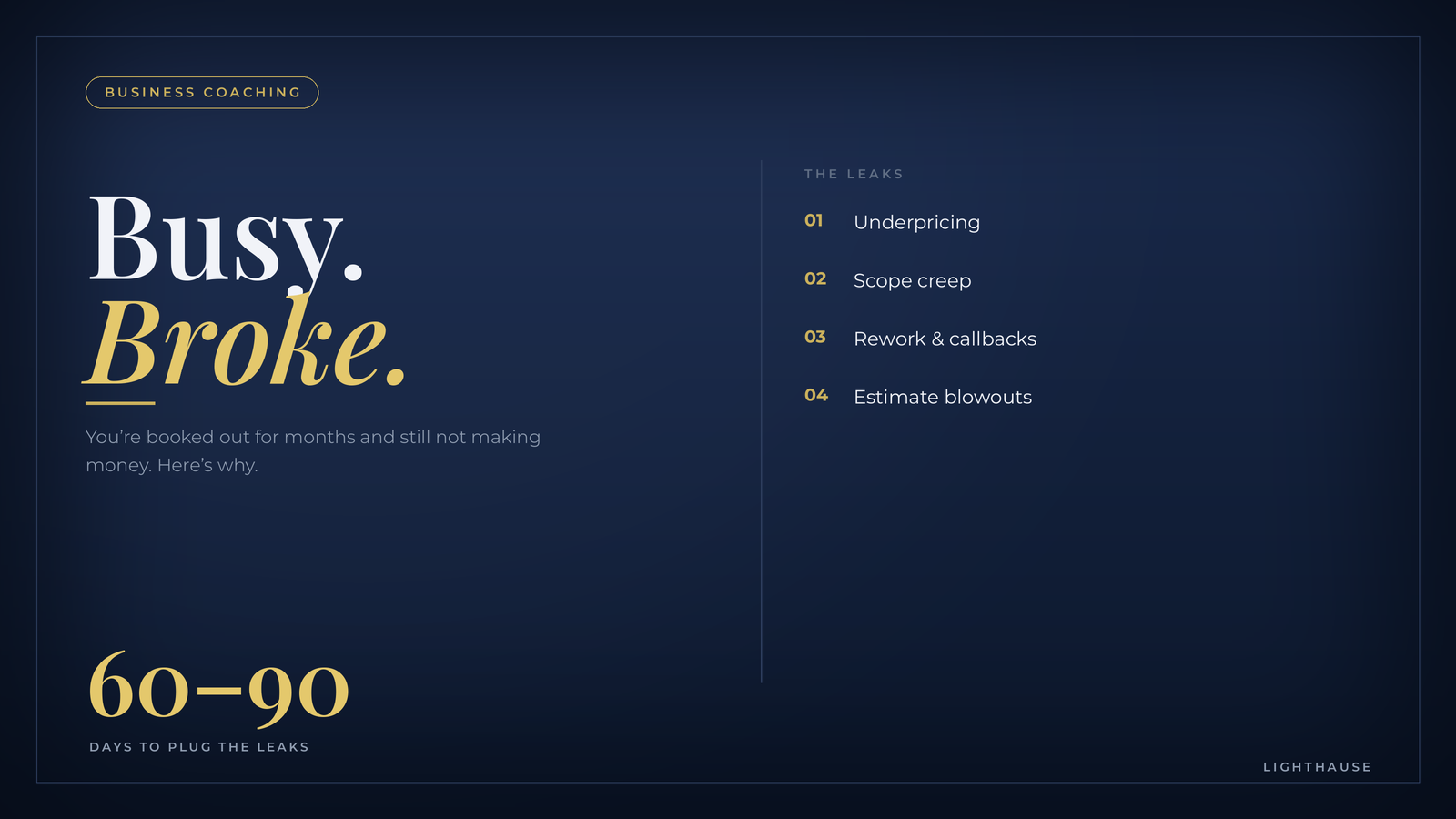
You’re Booked Out for Months and Still Not Making Enough Money.
Most trade businesses are worth less than the owner thinks, because the owner is the business. Here's what changes that, and when to start.
If your trade business is booked out but still not making the money it should, the problem usually isn't more leads — it's a margin leak. In most trade businesses, profit is escaping in the same six places: pricing, uncharged variations, rework, estimate blowouts, unbillable labour, and discounting. Fix the leak before chasing more demand.
You’re booked out for months.
The phone keeps ringing. The pipeline looks full. You’re quoting at night, on site during the day, answering calls in the ute and trying to keep the team moving.
From the outside, the business looks like it’s flying.
So why does the bank account still feel tight?
Why does BAS feel like a punch in the face every quarter?
Why are you working harder than ever, but not taking home what you should?
If that sounds familiar, the first instinct is usually:
“We just need more work.”
Or:
“We need bigger jobs.”
Or:
“We need more leads.”
But if you’re already booked out, more work probably isn’t the answer.
In a leaky business, more work can make the problem worse.
Because the real issue usually isn’t revenue.
It’s margin.
The money is disappearing somewhere between the quote you sent and the cash that lands in your account.
And in trade businesses, it tends to leak from the same places over and over again.
Why more work won’t fix a margin problem
Let’s make the maths simple.
If your business is doing $1M in revenue and netting 10%, you’re left with $100K profit.
If you want to make another $100K by chasing more revenue, you need to add another $1M in work at the same margin.
That means more quoting, more jobs, more pressure, more staff, more admin, more site issues and more risk.
Now compare that to fixing the margin.
If you lift net profit from 10% to 18% on the same $1M revenue, you add $80K profit without needing another $1M of work.
Same crew.
Same trucks.
Same workload.
More money left over.
That’s the game most busy trade businesses miss.
If the business is already full, the fastest path to profit usually isn’t more volume.
It’s fixing the leak.
Leak 1: You’re underpricing and you probably don’t know it
Most trade businesses don’t underprice because they’re careless.
They underprice because their old pricing model never caught up with the real cost of delivery.
Wages went up.
Materials went up.
Super went up.
Insurance went up.
Vehicle costs went up.
Tools, fuel, software, admin and overheads all crept up.
But the rates stayed close to where they were years ago.
So the business is busy, but every job is carrying a thinner margin than the owner realises.
The fix starts with knowing your true cost to deliver.
Not a gut feel.
Not “we should be right on that.”
Your real cost.
Labour with on-costs.
Materials.
Subcontractors.
Vehicle and tool costs.
Overhead allocation.
Admin time.
Super, leave, insurance and downtime.
Once you know the real cost by job type, you can see which work is profitable and which work just keeps the team busy.
A lot of owners discover they don’t need more jobs.
They need better-priced jobs.
Leak 2: Scope creep is being done for free
This is one of the quietest profit killers in trade businesses.
The job gets quoted.
The team gets on site.
The client asks for a few extra bits.
Your guys do it because it seems easier than stopping to get approval.
Then the invoice goes out based on the original scope.
No variation.
No extra charge.
No margin left.
The owner usually finds out later, if they find out at all.
The problem is not just paperwork.
It’s authority.
Your team needs to know exactly what counts as a variation and what they’re allowed to say when the client asks for more.
A simple line can save thousands:
“That’s outside the original scope. I’ll get that priced before we go ahead.”
That’s not being difficult.
That’s running a professional business.
Good clients respect it.
The clients who push back on paying for extra work are usually the same ones creating the margin problem in the first place.
Leak 3: Rework and callbacks are coming straight out of profit
Every callback hurts.
Every redo.
Every “we’ll just go back and sort it.”
Every extra trip.
Every job that should have been finished but wasn’t.
You’ve already invoiced the work.
So the cost of going back comes straight out of your margin.
And because most trade businesses don’t track rework properly, it gets absorbed into the chaos.
The team is busy.
The calendar is full.
Everyone moves on.
But the profit has already disappeared.
The fix is visibility.
Track rework and callback hours for 60 days.
Not forever.
Just long enough to see the pattern.
Then ask:
Which job types keep causing rework?
Which team members are involved?
Which scopes were unclear?
Which handovers were rushed?
Which materials or suppliers keep causing problems?
Most businesses don’t have 20 different rework issues.
They have two or three repeat causes that keep showing up.
Fix those and the impact on profit can be massive.
Leak 4: Jobs blow the estimate and nobody notices in time
You allowed 40 hours.
The job took 62.
You invoiced like it was 40.
That margin is gone.
The issue isn’t that jobs sometimes run over. That happens.
The issue is when there’s no feedback loop.
No one reviews estimated versus actual hours.
No one updates the pricing.
No one changes the next quote.
So the same type of job gets underquoted again.
And again.
And again.
This is where job costing matters.
You don’t need a complex system to start.
You need to know:
What did we allow?
What did it actually take?
Why was there a gap?
Is this a one-off or a pattern?
If a certain type of work keeps taking 25% more labour than expected, that’s not bad luck.
That’s a pricing problem.
And it should be fixed on the next quote.
Leak 5: Labour is being paid for but not billed
If you have a team, not every paid hour turns into billable work.
Some non-billable time is normal.
Travel.
Loading.
Material runs.
Site delays.
Access issues.
Waiting on decisions.
Fixing mistakes.
Helping other team members.
Admin.
The problem is when no one knows how much of the week is actually productive.
If your team is paid for 200 hours this week, how many of those hours created invoiceable work?
Most owners don’t know.
They just feel the wage bill.
That’s a dangerous place to run from.
You don’t need to track every minute forever.
But you do need a simple view of labour utilisation.
How much time is billable?
How much is lost?
Where is it going?
Once you see it, you can fix the real cause.
Better scheduling.
Better material readiness.
Better site sequencing.
Better job handovers.
Better accountability.
The margin is often hiding in the calendar.
Leak 6: Discounting is quietly killing your profit
Discounting feels small in the moment.
A client pushes back.
You shave a bit off.
You win the job.
Everyone moves on.
But the maths is brutal.
If a job has a 30% gross margin and you discount the price by 10%, you haven’t given away 10% of your profit.
You’ve given away roughly a third of it.
That’s the part most teams don’t understand.
They think they’re protecting revenue.
But they’re destroying margin.
Discounting needs rules.
Who can approve it?
What is the maximum?
What is the reason?
Is the client strategic?
Is the job easy?
Is there repeat work?
Are we discounting because it makes commercial sense, or because someone got nervous?
If discounting isn’t tracked, it becomes a habit.
And habits become margin leaks.
How to find your biggest profit leak
You don’t need to fix everything at once.
In most trade businesses, two or three leaks are doing most of the damage.
Start with five questions:
What was your actual net profit margin over the last 12 months?
Do you know the true loaded cost of your three most common job types?
How many jobs last quarter ran over estimated hours?
How often are variations approved before the work is done?
How many hours did rework and callbacks cost last month?
The questions you can’t answer are usually pointing at the problem.
Not knowing the number is part of the diagnosis.
Because if you can’t see the leak, you can’t fix it.
Why busy businesses can still go backwards
This is the hard truth.
A business can grow revenue and still get weaker.
More jobs.
More staff.
More pressure.
More complexity.
More mistakes.
More unpaid variations.
More callbacks.
More admin.
More stress.
And not enough extra profit to justify it.
That’s why “we need more leads” can be the wrong answer for a booked-out trade business.
If the machine is leaking, more demand just pushes more work through a broken system.
You get busier.
Your team gets stretched.
The mistakes increase.
The owner gets pulled back into everything.
And the bank account still doesn’t show the effort.
That is not a lead problem.
That is a profit leak problem.
Fix the leak before you chase the next level
The goal is not to be busy.
The goal is to build a business that produces strong, reliable profit without the owner having to carry everything.
That means fixing the work you already have before chasing more.
Pricing properly.
Charging variations.
Tracking rework.
Reviewing estimated versus actual hours.
Improving labour utilisation.
Setting rules around discounts.
Knowing which jobs to say no to.
That’s how a trade business becomes stronger.
Not just bigger.
Because bigger only helps if the margin is there.
Frequently asked questions
Why is my trade business busy but not profitable?
Usually because margin is leaking somewhere between the quote and the payment.
Common causes include underpricing, uncharged variations, rework, estimate blowouts, unbillable labour and discounting.
The work is coming in, but the profit is escaping before it reaches your account.
How do I know if I’m underpricing?
A few signs usually show up.
You win almost every quote.
Clients rarely push back.
The business is busy, but cash is always tight.
Your rates haven’t been reviewed properly in years.
You don’t know your true cost to deliver by job type.
If your quote conversion rate is extremely high, that can also be a warning sign. It may mean the market is telling you your price is too easy to say yes to.
How do I stop scope creep without upsetting clients?
Set the expectation early.
When something is outside the original scope, your team needs to say:
“That’s outside what we quoted. I’ll get that priced before we go ahead.”
That protects the client and the business.
It avoids awkward invoice conversations later and makes the process clear from the start.
What net margin should a trade business aim for?
It depends on the trade, job type, team structure and overhead base.
But if a business is consistently sitting in low single-digit net profit while the team is flat out, that’s a strong sign something is leaking.
A better question is:
What margin should this business be making based on the risk, workload and capital involved?
Then work backwards from there.
Should I just put prices up?
Often, yes.
But don’t do it blindly.
Start with your real cost to deliver.
Look at which job types are underpriced.
Review your gross margin by job type.
Then increase prices where the data shows the margin is too thin.
A good price rise does two things.
It improves profit.
And it filters out low-margin, high-hassle clients who were never worth keeping.
Find your biggest profit leak
If you’re booked out, working flat out and still not making enough money, the answer probably isn’t more work.
It’s finding where the profit is leaking.
Start with the free strategy session.
You’ll get a clear read on where your margin is disappearing across pricing, variations, rework, labour, quoting and discounting.
From there, you’ll know the first move to fix it, so the work you’re already doing actually pays you what it should.
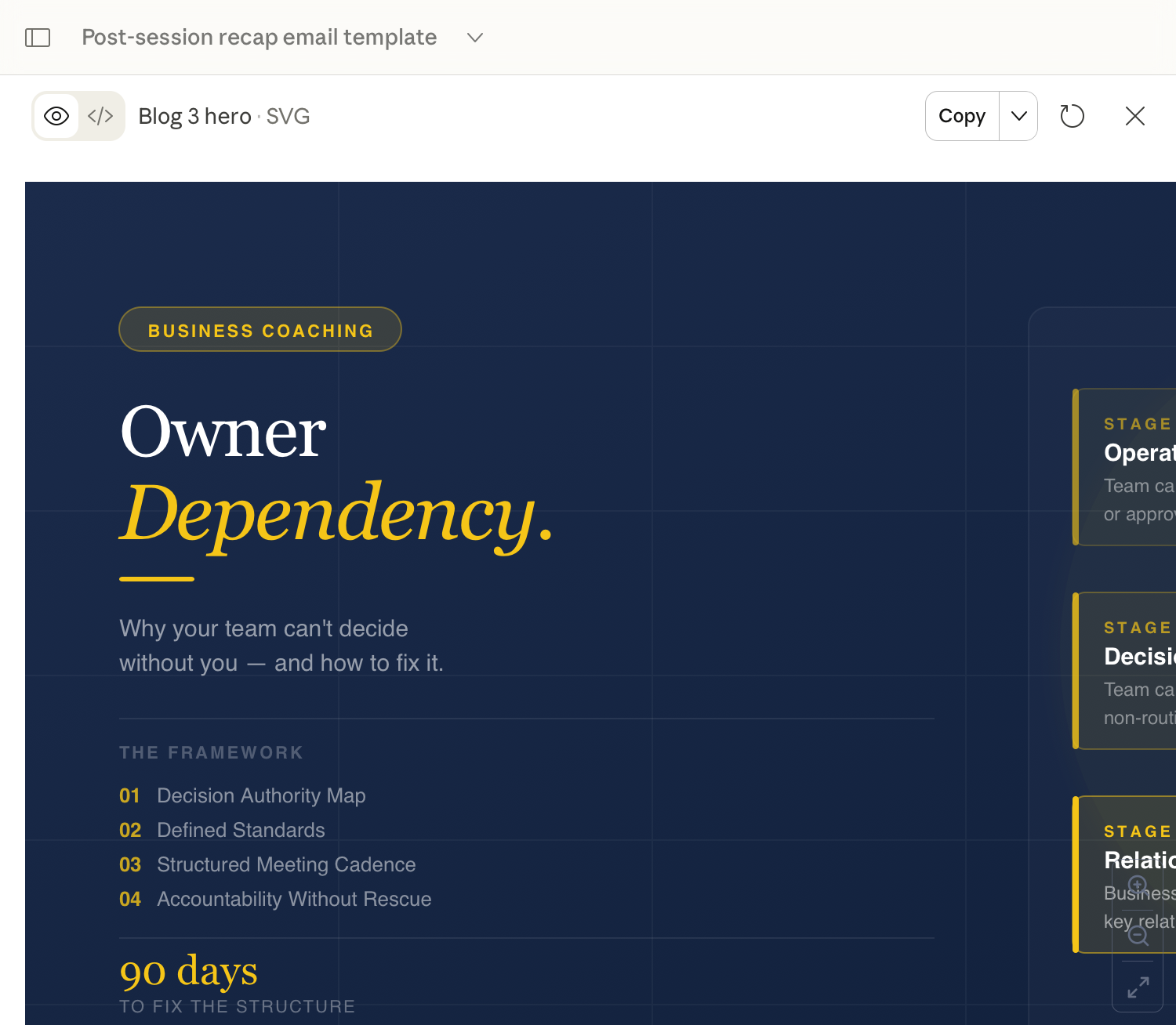
How to Reduce Owner Dependency in a Service Business | Lighthause
If every decision still comes back to you, you’ve got owner dependency. This guide explains why it happens and the framework that helps your team make decisions without you, so the business stops relying on the owner for everything.
You built a team so you could work less in the business. Instead, you're managing more. Every decision still comes back to you. Every problem still ends up on your plate. The team is there — but somehow, you're still the one running everything.
This is owner dependency. And it's one of the most frustrating positions a service business owner can find themselves in — because the solution seems obvious (just let your team do more) but the reality of actually making that happen is far harder than it looks.
This is business coaching for service business owners focused on reducing owner dependency, improving team accountability, and building a business that doesn’t bottleneck through the owner.
This article explains exactly why owner dependency persists even when owners genuinely want to step back — and lays out the structural framework that actually fixes it.
Why Owner Dependency Isn't a People Problem
The instinctive explanation for owner dependency is a team problem. Your people aren't capable enough. They don't take initiative. They need too much direction. If you just had better people, this wouldn't happen.
That explanation is almost always wrong.
In most cases, the team is more capable than the owner believes — but they're operating inside a structure that makes independent decision-making impossible or unsafe. They default to the owner not because they can't think for themselves, but because the system around them rewards deference and punishes independent action.
"I'm paying for help and still carrying the responsibility. Every hire added more to watch, fix, or redo — not less."
Think about what your team actually experiences day to day. They make a decision. You reverse it. Or you redo it. Or you give feedback that implies they should have checked with you first. Over time, the rational response to that environment isn't to develop more confidence and judgment — it's to ask before acting. You trained them to be dependent, even if you never intended to.
Owner dependency is a structural problem. The structure of your business — how decisions get made, how authority is distributed, how performance is defined — creates the dependency. Change the structure, and the behaviour changes with it.
The Three Stages of Owner Dependency
Not all owner dependency looks the same. Understanding which stage you're in helps identify the right fix.
STAGE 01
Operational Dependency
Your team can't execute without your involvement. They need instructions, approvals, or oversight on day-to-day tasks — quoting, scheduling, client communication, delivery. You're functioning as a manager and doer simultaneously, and your capacity is the hard ceiling on output.
STAGE 02
Decision Dependency
Your team can execute tasks but can't make decisions. They can do the work but can't say yes to a variation, handle a difficult client conversation, or resolve a problem without escalating to you. You're not running the day-to-day work, but you're still the decision-maker for anything outside routine.
STAGE 03
Relationship Dependency
Your team can execute and make operational decisions, but your key client and supplier relationships sit with you personally. The business runs — until a major client calls, a key supplier negotiation arises, or a high-stakes problem emerges. At that point, everything still routes back to you.
Most businesses dealing with owner dependency are sitting somewhere between Stage 1 and Stage 2. Stage 3 is actually a relatively healthy problem to have — it means the operational structure is working. Getting from Stage 1 or 2 to Stage 3 is where the real work is.
Why Fixing It Is Harder Than It Looks
Every owner who struggles with dependency has tried some version of "just letting go." It didn't work. Here's why.
You haven't defined what good looks like
Your team can't meet a standard you haven't articulated. You have a clear picture in your head of what quality output looks like, how client conversations should be handled, what an acceptable decision looks like. Your team doesn't have that picture. They're guessing — and when they guess wrong, they get corrected, which reinforces the instinct to ask rather than act.
Authority is ambiguous
There's a difference between telling someone they're responsible for something and actually giving them the authority to make decisions about it. Most owners say they want their team to own their areas. But when the team acts on that ownership, the owner steps in — with a different view, a better idea, or a correction. The message received isn't "you own this." It's "you own this until I disagree."
There's no safety net for mistakes
In a well-structured business, people learn by making decisions and experiencing consequences. In an owner-dependent business, the owner is the safety net — they catch everything before it fails. This feels responsible. In practice, it prevents your team from ever developing the judgment and confidence that comes from real accountability. They stay junior. You stay busy.
The owner is still the hero
In many owner-dependent businesses, the owner's involvement is actually rewarded by clients. Clients like dealing with the founder. They trust the owner more than the team. The owner's involvement in solving problems generates client satisfaction. This feels good — and it is genuinely valuable. But if it prevents the business from ever running without the owner, it's a liability that will cap growth indefinitely.
The Framework for Reducing Owner Dependency
These four elements, built in order, create a business that can operate and grow without the owner being in the middle of everything.
The Owner Dependency Framework
1
Decision Authority Map. Document every type of decision made in your business. Assign each one to a role: who decides, who is consulted, who is informed. Be explicit. "Use your judgment" is not authority — it's ambiguity. Real authority is "you can approve variations up to $2,000 without checking with me." Once documented, hold the line. When someone brings you a decision that sits in their authority zone, redirect them.
2
Defined Standards. For every key output your business produces — quotes, client communications, delivery quality, internal reporting — write down what good looks like. Not a vague brief. A specific, observable description that allows your team to self-assess before handing work up. When the standard is clear, your team can match it without asking. When it isn't, they'll always need your input.
3
Structured Meeting Cadence. One of the biggest drivers of owner dependency is unstructured access. If your team can reach you any time, they will — for things that could wait, for questions they could answer themselves, for reassurance they've come to rely on. Replace ad-hoc access with structured rhythm: weekly team meeting, weekly 1:1s, a clear format for raising issues. Predictable access reduces reactive access.
4
Accountability Without Rescue. The hardest part. When your team makes a decision that you wouldn't have made, resist the urge to step in. When something goes wrong that you could have prevented, let the consequence happen and debrief rather than catching it. This isn't negligence — it's the only way your team develops real judgment. Set the guardrails (the authority map and standards), then let people work within them without the safety net of your constant oversight.
What This Actually Looks Like in Practice
Jamie Montalto ran his fitness business as a solo operator for years before it started to grow. By the time he had 22 trainers across 14 gyms, he was still involved in every staffing decision, every client complaint, and every equipment purchase. The team was large but completely dependent.
"From a solo operator to 22 trainers, 14 gyms, and a 7-figure fitness business. The business grew because he stopped being the ceiling."
The structural changes that allowed Jamie to step out weren't complicated. A clear hierarchy of decision-making by gym manager. A defined standard for trainer onboarding and client experience. A weekly ops meeting where issues got raised and resolved without him. And a deliberate period of non-intervention — letting the managers handle situations he would previously have owned.
Within 90 days, day-to-day operations were running without him. Within six months, he was working on the business — new locations, new partnerships, the growth work he'd been putting off for years — instead of in it.
That's the arc. It's uncomfortable in the middle. It produces a fundamentally different business at the end.
The Owner's Role After Dependency Is Resolved
A common fear is that reducing owner dependency means becoming irrelevant. It doesn't. It means changing what you're relevant for.
Before: You're involved in delivery, decisions, client escalations, team management, and the day-to-day operational running of the business. You're essential everywhere and therefore strategic nowhere.
After: You're involved in strategy, key relationships, growth decisions, and the development of your leadership team. You're essential where only you can add value — and liberated from everything else.
The businesses that grow past $2M, $5M, and beyond aren't run by founders who are essential to operations. They're run by founders who built structures that don't require them — and then focused their energy on the things that genuinely move the needle.
That transition doesn't happen automatically. It requires deliberate structural work, real accountability, and usually a period of genuine discomfort. But the alternative — staying indispensable in a business that can't grow past your own capacity — is a worse outcome.
Ready to build a business that runs without you?
Want help fixing owner dependency properly?
If you’re doing $500k–$2m+ and your team still can’t move without you, I’ll help you map decision authority, set clear standards, and build the rhythms that make the business run without you being the middleman.
Apply to work with Lighthause and I’ll get back to you within 24–48 hours.
Frequently Asked Questions
How do I reduce owner dependency without losing quality control?
The key is building quality into the system rather than maintaining it personally. Defined standards, clear checklists, and structured review processes mean quality gets maintained without your constant involvement. You shift from being the quality control to designing the quality control system. That's a more scalable and more reliable approach — because it doesn't depend on your availability.
What if my team genuinely isn't capable of operating without me?
In most cases, the capability exists but the structure doesn't support it. Before concluding you have a capability problem, ask whether you've given your team explicit authority, clear standards, and real accountability. Most owners who do this are surprised by how much their team can handle. If after genuinely testing this you still have a capability gap, that's a hiring and development problem — which is solvable, but different from a structural problem.
How long does it take to reduce owner dependency?
Most owners see meaningful change within 60 to 90 days when they implement structural changes deliberately. The first 30 days involves building the decision authority map and defining standards. Days 30 to 60 involve establishing the meeting cadence and beginning the non-intervention practice. By 90 days, most operational decisions are being made without the owner, and the pattern of deference starts to break down.
Is owner dependency worse in some industries than others?
It's particularly acute in trade businesses, professional services, and specialist firms where the owner's technical expertise is genuinely superior to the team's — and where clients specifically value working with the founder. The structural fixes are the same across industries, but the cultural work of transitioning client relationships away from the owner tends to take longer in these contexts.
What role does business coaching play in reducing owner dependency?
Business coaching for service business owners accelerates the process in two specific ways. First, an outside perspective can see the structural problems clearly — the owner is often too close to their own business to diagnose them accurately. Second, accountability from a coach provides the forcing function that most owners need to actually make the changes rather than defer them. Owner dependency is rarely solved by awareness alone. It's solved by structural change with accountability driving it.
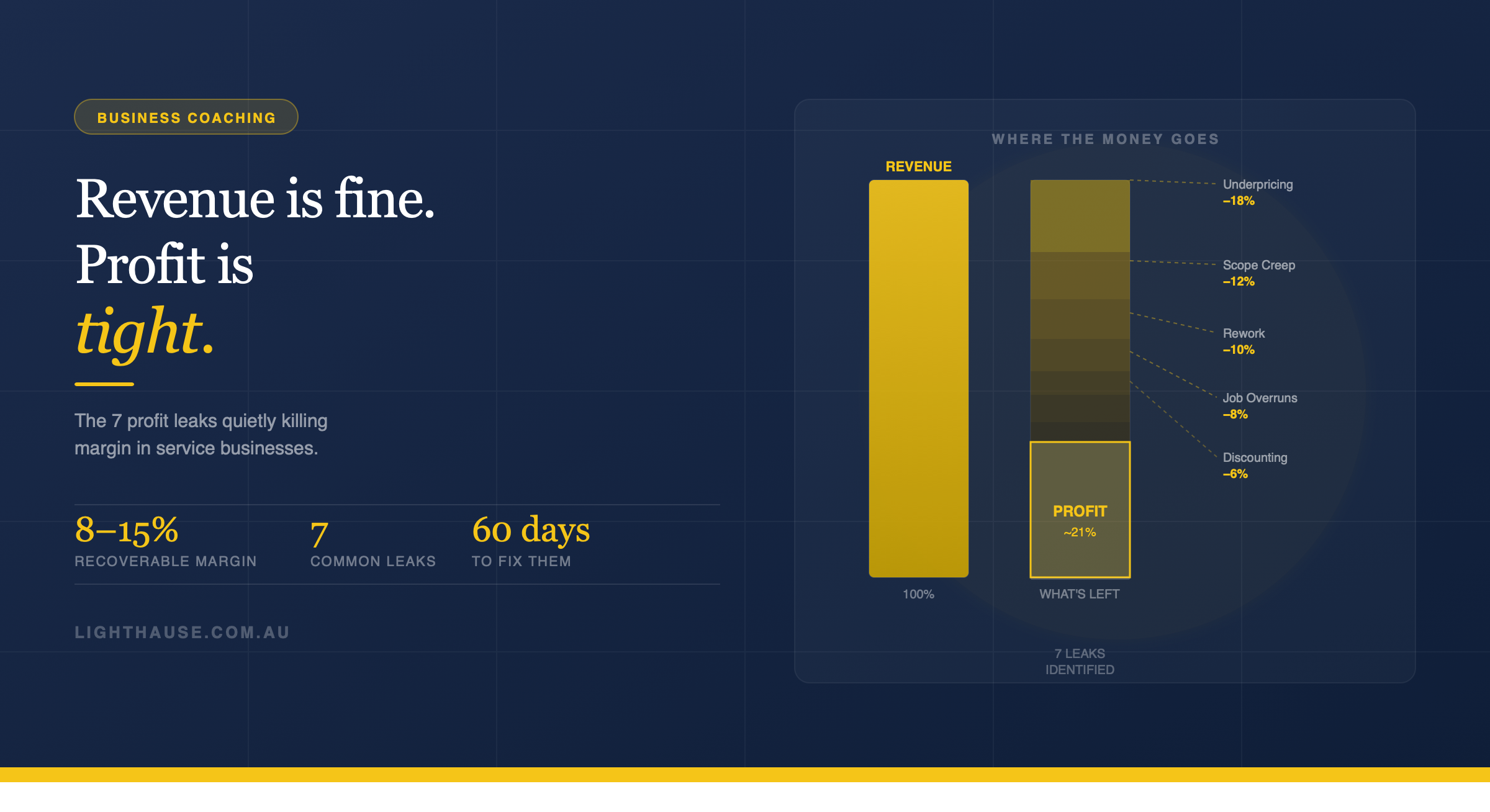
Revenue is Fine But Profit is Tight: The 7 Profit Leaks Quietly Killing Margin in Service Businesses
Revenue looks fine but profit’s still tight? This guide breaks down the 7 profit leaks quietly killing margin in service businesses and the practical fixes that recover profit in 30–90 days.
Most service business owners know their revenue number. Very few actually know their margin. And the gap between the two — the money that disappears between invoicing and paying yourself — is almost always explained by the same seven problems.
This isn't about working harder or winning more clients. You might already be doing both. The issue is structural: there are specific, fixable leaks in your business that are quietly consuming the profit that should be landing in your account.
This is business coaching for service business owners focused on increasing profit, tightening margin, and removing the operational leaks that keep profit tight even when revenue is fine.
Here's what they are, how to find yours, and what to do about them.
First: Why Profit Problems Feel Like Revenue Problems
When margin is tight, the instinctive response is to go get more work. More clients, more jobs, more revenue. And that works — until it doesn't.
The problem is that if your margin is 12% and you want to take home an extra $100K, you need to win an extra $830K in revenue to get there. That's a massive amount of sales effort to compensate for what is, in reality, a structural problem.
Fix the leaks first. The same revenue base produces significantly more profit when the margin problems are resolved. Most service businesses we work with find 8 to 15 percentage points of recoverable margin — money they're already earning, that's just disappearing before it reaches the bottom line.
"Revenue looks decent. But somewhere between 'just do it for them,' rework, and jobs that take longer than we priced — it's hard not to feel ripped off by my own business."
That feeling is diagnostic. It tells you the leaks exist. The job is finding exactly where they are.
The 7 Profit Leaks in Service Businesses
LEAK 01
Underpricing — and Not Knowing It
Most service business owners set their prices years ago, when they needed work, when they were less experienced, or when they were nervous about losing clients to cheaper competitors. Those prices rarely get reviewed. Meanwhile, your costs have gone up, your team has grown, and your value has increased — but your rates haven't kept pace.
Underpricing is the most common profit leak in service businesses and the hardest one to see clearly, because the revenue still looks reasonable. The jobs are coming in. The invoices are going out. But the gap between what you're charging and what it actually costs you to deliver is slowly eating you alive.
The fix starts with a proper cost-to-deliver analysis for every service type you sell. What does it actually cost — in labour, overhead allocation, and time — to deliver this work? Once you know that number, the right price becomes obvious. Most owners who do this exercise discover they need to increase rates by 15 to 30% on at least some of their service lines.
LEAK 02
Scope Creep That Nobody Is Tracking
You quoted the job. The client asked for a few extras along the way. Your team just did them — because it seemed easier than having the conversation. The invoice went out for the original scope. The job cost 40% more to deliver.
Scope creep is the silent margin killer in almost every service business. It happens at the job level, it's almost never tracked systematically, and it compounds quietly until you've essentially done a significant percentage of your work for free.
The structural fix is a clear change-order process: any work outside the original scope gets flagged, priced, and approved before it's done. Not after. This requires your team to understand the scope boundaries and have the confidence to have the conversation with clients. That's a training and authority problem as much as a process problem — and it's worth solving properly.
LEAK 03
Rework That Eats Time and Gets Absorbed
Jobs that need to be redone, fixed, or revisited after delivery are pure margin destruction. You've already invoiced. The rework cost comes entirely out of profit. And in most businesses, it isn't even tracked — it just gets absorbed into the chaos of delivery and never shows up as a discrete cost.
The cause of most rework is upstream: unclear briefs, rushed handoffs, poor job specifications, or insufficient quality checks before delivery. The fix isn't working harder at the rework stage — it's building the systems that prevent the rework from happening in the first place.
Start by tracking rework hours for 60 days. The number will surprise you. Then trace each instance back to its root cause. You'll find the same two or three failure points responsible for 80% of your rework — and fixing those has an outsized impact on margin.
LEAK 04
Jobs That Run Over Budget and Nobody Notices
You estimated 12 hours. The job took 19. You invoiced for 12. That's a 58% cost overrun on that job — absorbed with no visibility, no accountability, and no adjustment to future pricing. Multiply that across your job volume and the margin destruction is significant.
The issue in most businesses isn't that jobs run over — it's that there's no system to catch it when they do and no process to understand why. Actual vs. estimated hours needs to be tracked at the job level, reviewed regularly, and used to improve both your estimating and your delivery processes.
This data also tells you which job types are systematically mispriced — the categories where you consistently underestimate because the real delivery complexity has never been properly costed. That's pricing information you can act on immediately.
LEAK 05
Staff Time That Isn't Billable or Productive
If you have a team, a significant portion of their paid time is almost certainly not generating revenue. Administration, travel, waiting, internal meetings, fixing mistakes, doing work that's outside their role — it all costs you money while producing nothing you can invoice.
Most service businesses have no clear picture of what their team actually does with their time. They track hours on jobs (sometimes) but not the overhead that surrounds the jobs. Understanding your real utilisation rate — the percentage of paid time that's genuinely productive and billable — is one of the most revealing diagnostics you can run on your business.
In a healthy service business, utilisation sits at 65 to 75% for delivery staff. If yours is lower, the gap is your margin opportunity. Fixing it usually requires better job scheduling, clearer role boundaries, and honest conversations about how time is actually spent.
LEAK 06
Discounting That's Become a Habit
It started as a strategic decision — a discount to close a deal, keep a valued client, or win a job during a quiet period. But somewhere along the way it became the default. Your team quotes a number, the client pushes back, and the discount happens automatically without real consideration of the margin impact.
Discounting is one of the most margin-destructive habits in service businesses because the impact is disproportionate. A 10% discount on a 30% margin job doesn't reduce your profit by 10%. It reduces it by a third. Most owners don't think about it in those terms — and their teams certainly don't.
The fix is simple but requires discipline: set a discount approval threshold and stick to it. Discounts above a certain level require your sign-off or a defined business reason. Track the discounts that happen. Review them. You'll quickly see whether they're genuinely strategic or just conflict avoidance.
LEAK 07
Overhead That Has Grown Unchecked
In a growing service business, overhead tends to accumulate quietly. Subscriptions added and forgotten. Staff headcount that outpaced revenue growth. Premises that made sense two years ago but are now oversized. Each individual cost feels manageable — but together they've raised your break-even significantly without a corresponding increase in revenue.
A proper overhead review — done once a year at minimum — almost always surfaces meaningful savings. Not dramatic cuts, but the kind of waste that creeps in when costs aren't scrutinised regularly: software nobody uses, suppliers who haven't been renegotiated, roles that have evolved beyond what's needed.
More importantly, understanding your overhead structure tells you what your minimum viable revenue is — the number below which the business loses money regardless of how hard you work. If that number has crept up without you noticing, your margin is under more pressure than your revenue growth has compensated for.
How to Find Your Biggest Leak
The Quick Diagnostic
Pull your last 12 months of revenue and net profit. What's your actual margin percentage?
Pick your three highest-volume job types. Do you know the real cost to deliver each one?
How many jobs in the last quarter ran over their estimated hours? By how much?
What percentage of your last 20 quotes included a discount? What was the average discount?
What did your rework cost you last month in labour hours?
What's your overhead as a percentage of revenue? Has it increased in the last 12 months?
You don't need to answer all of these immediately — but the ones you can't answer are usually pointing directly at your biggest leak. Uncertainty about your numbers is itself diagnostic information.
In most businesses, two or three of these seven leaks account for the majority of the margin problem. Fix those first. Don't try to tackle all seven simultaneously — it dilutes focus and slows everything down.
What Fixing the Leaks Actually Looks Like
The conversation about profit leaks is easy. The implementation is harder — not because the fixes are complex, but because they require behaviour change from you and your team, and behaviour change requires accountability.
Pricing reviews get deferred because raising prices feels risky. Change order processes get ignored because having the conversation with clients is uncomfortable. Rework tracking doesn't happen because nobody wants to surface the data. These are cultural and structural problems, not information problems.
The businesses that fix their margin fastest are the ones with a forcing function: someone outside the business holding them accountable for the changes, helping them navigate the client conversations, and making sure the systems actually get built and used — not just discussed and forgotten.
"We identified the capacity constraints, fixed the pricing model, and built a referral system that brought in consistent work. Revenue doubled in 12 months." — Nathan, Crackers Clear Out
A 5 percentage point improvement in margin on a $1M revenue business is $50,000 in additional profit on the same revenue base. For most service businesses, that's achievable in a single quarter once the leaks are identified and addressed systematically.
Find out where your margin is going
Want help fixing margin properly?
If you’re doing $500k–$2m+ and profit feels tight, I’ll help you find the 2–3 real leaks in your business and build the pricing, change-order, and delivery systems to keep the profit you’re already earning.
Apply to work with Lighthause and I’ll get back to you within 24–48 hours.
What is a healthy profit margin for a service business?
It varies by industry, but as a general benchmark, service businesses should target net profit margins of 15 to 25%. Trades and construction businesses often run lower (10 to 18%) due to material and labour costs. Professional services and consulting businesses can run higher (20 to 35%). If you're consistently below 10% net margin, you almost certainly have one or more of the seven leaks operating in your business.
How do I know if I'm underpricing my services?
The clearest signal is that you're winning most of your quotes. A win rate above 70 to 75% usually means you're leaving money on the table — your prices are low enough that clients say yes too easily. Other signals include consistently tight cash flow despite reasonable revenue, clients who never push back on price, and the inability to remember the last time you raised your rates.
How do I stop scope creep without damaging client relationships?
The key is having the conversation early and framing it as professionalism, not inflexibility. "That's outside what we quoted — I'll get you a price for it before we proceed" is a statement that most clients respect. Clients who push back on change orders are often the same clients who generate the most rework and the most margin problems. A clear change order process actually builds trust with good clients, because it demonstrates that you manage your work precisely.
Should I raise prices even if I'm worried about losing clients?
Almost certainly yes — but do it strategically. Start with new clients and new quotes. Review your client list and identify the 20% of clients who generate the most problems, demand the most discounts, or produce the most rework. These are the clients most worth losing. Raising prices often naturally filters them out, improving your overall margin even if volume drops slightly. For your best clients, a well-communicated price increase with adequate notice is rarely the threat it feels like.
How quickly can a business coach help improve profit margins?
Most clients working with Lighthause see measurable margin improvement within 60 to 90 days. The first step is always a clear diagnostic — identifying which two or three leaks are responsible for the bulk of the problem. From there, the fixes are structural: pricing frameworks, change order processes, rework tracking, overhead reviews. These can be implemented quickly when there's focus and accountability driving them.
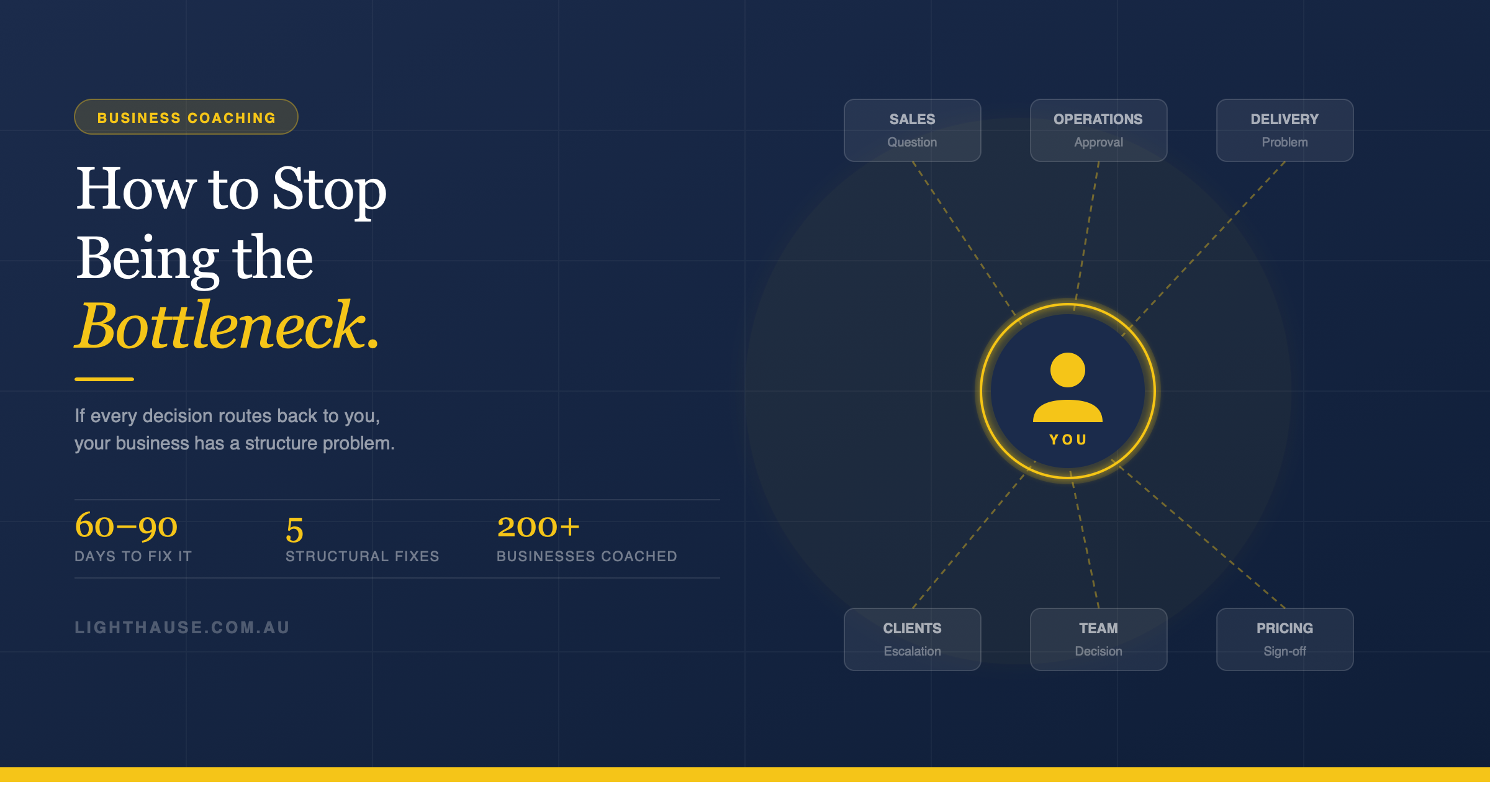
How to Stop Being the Bottleneck in Your Service Business
If your service business can’t move without you, you don’t have a team problem, you have a structure problem. This guide shows why owner dependency happens and the practical fixes that reduce it, so decisions get made, the team steps up, and the business stops bottlenecking through you.
If your business can't move without you — if decisions wait for your approval, problems route to your inbox, and you're the last checkpoint for everything — you don't have a team problem. You have a structure problem.
And it's one of the most common ceilings in service businesses doing $500K to $2M+.
You built the business. You know how everything works. You're the one clients trust, the one your team defaults to, the one who fixes things when they go sideways. That was fine when you were smaller. But now it's the thing stopping you from growing — and from stepping back.
This is business coaching for service business owners focused on reducing owner dependency, increasing profit, and building team accountability so the business can grow without everything depending on you.
This article breaks down exactly why owner dependency happens, how to diagnose your version of it, and the structural changes that actually fix it.
Why You Became the Bottleneck
It didn't happen because you hired badly or because your team is incapable. It happened because the business was built around you — your decisions, your standards, your relationships, your availability.
In the early days, that made sense. You were the product. Your judgment was the quality control. Your hustle was the pipeline.
But as the business grew, the structure didn't keep up. You added people without adding clarity. You gave them tasks without giving them authority. You stayed involved in everything because stepping back felt like losing control — and frankly, it was faster to just do it yourself.
"Nothing really moves until it comes back to me — pricing, expectations, approvals. Even with a team, I'm still the checkpoint everything routes through."
That's owner dependency. And left unchecked, it creates a hard ceiling on what the business can become.
The Real Cost of Being the Bottleneck
Most founders underestimate the compounding damage of staying in the middle of everything. Here's what it actually costs:
It caps your revenue
If your capacity is the constraint, revenue can only grow as fast as you can work. Every project, every decision, every client escalation that requires you means the business is limited to what one person can handle. You hit a number and bounce off it, year after year, wondering what's wrong.
It keeps you doing the wrong work
When you're the bottleneck, your days fill with reactive work — questions from your team, fires to put out, approvals to sign off. The strategic work, the growth work, the things only you can actually do — those get squeezed into nights and weekends, or don't happen at all.
It prevents your team from developing
People learn by making decisions and living with the consequences. If every decision routes back to you, your team never develops judgment. They stay dependent. You stay trapped. The cycle reinforces itself.
It makes the business unsellable
A business that requires the owner to function is worth significantly less than one that runs without them. If you ever want to exit, reduce your hours, or simply take a holiday without your phone, owner dependency is the single biggest obstacle.
How to Diagnose Your Bottleneck
Before you fix it, you need to understand exactly where you're sitting in the middle. Ask yourself these questions honestly:
What decisions does your team make without coming to you first?
What happens when you're unavailable for a day — does work continue or stall?
Are there any client relationships that exist primarily with you personally?
Does your team know what "good" looks like without asking you?
Are there recurring problems that keep coming back to you to solve?
The pattern you're looking for is: where does uncertainty default to you? That's where your bottleneck lives.
Most service business owners find they're the bottleneck in three specific places: pricing decisions, client escalations, and hiring/firing. These tend to be the areas where the owner's judgment feels irreplaceable — but they're also exactly where structural clarity can replace personal involvement.
The Five Structural Fixes That Actually Work
These aren't time management tips. They're structural changes — the kind that make it impossible for everything to route back to you, rather than just inconvenient.
1. Define decision authority explicitly
Your team defaults to you because they don't know what they're allowed to decide. The fix isn't telling them to "use their judgment" — it's giving them explicit decision authority by category.
Map out every type of decision that gets made in your business. Then assign each one to a role: who owns this decision, who gets consulted, and who gets informed after the fact. When someone comes to you with a question that falls in their authority zone, redirect them: "That's your call. What are you going to do?"
Do this once, document it, and your team's dependency on you for routine decisions drops significantly within 30 days.
2. Define "what good looks like" for every key role
Your team bounces work back to you because they're not confident their output will meet your standard. They've been burned before — you've redone their work, or given feedback that felt unpredictable.
The solution is to make your standard explicit. For every key deliverable your business produces, write down what a good version looks like. Not a vague brief — a specific, observable description of done. When your team has that, they can self-assess before coming to you. Most of the time, they won't need to come to you at all.
3. Build a cadence that replaces ad-hoc check-ins
One of the biggest drivers of owner dependency is poor rhythm. When there's no regular meeting structure, your team fills the gap with individual interruptions — messages, questions, quick calls that fragment your day and keep you in the middle of everything.
Replace ad-hoc access with structured cadence: a weekly team meeting, a weekly 1:1 with each direct report, and a clear agenda format. When people know they'll get facetime on Thursday, they batch their questions instead of firing them at you as they arise. Your availability becomes predictable, and your reactive load drops.
4. Fix your pricing authority problem
In most service businesses, pricing is one of the last decisions owners give up. And understandably — bad pricing decisions are expensive. But if every quote requires your review, you're creating a delay in your sales process and a dependency that will never go away.
The fix is to build a pricing framework that your team can apply consistently: job categories, day rates, scope triggers, and escalation thresholds. Define the rules once. Train your team to apply them. Reserve your involvement for the edge cases — large jobs, unusual scopes, sensitive clients — not every single quote.
5. Handle client relationships at the system level, not the personal level
If your best clients think of your business as you personally — if they call your mobile, expect you to be on every job, or would follow you if you left — that's a fragile business. You haven't built a company. You've built a personal services practice.
The transition is uncomfortable but necessary. Start introducing your team as the point of contact for operational matters. Let them handle the day-to-day relationship. You stay involved at the strategic and relationship level — but the business relationship should be with your company, not with you personally.
What to Expect When You Start Letting Go
Be honest with yourself: the first few months of reducing your involvement will feel worse before it feels better.
Your team will make decisions you wouldn't have made. Some clients will notice the change and comment on it. Things will slip through the cracks that you would have caught. This is normal — and it's the cost of building a business that can function without you.
The alternative is staying exactly where you are: capable, competent, and completely trapped by your own business.
"The business grew because he stopped being the ceiling."
Most owners who commit to this process start seeing real change within 60 to 90 days. Not perfection — but a business that moves without them being in the middle of everything. Decisions getting made. Problems getting solved. And a calendar that finally has room for the work that actually grows the business.
When to Get Help
These structural changes are straightforward in principle. In practice, most owners find they need a forcing function — someone outside the business who can see the pattern clearly, hold them accountable for the changes, and help them navigate the discomfort of letting go.
If you've been aware of your bottleneck problem for more than six months and haven't fixed it, that's a signal. The issue isn't awareness — it's structure, accountability, and having the right support to make the changes stick.
Business coaching for service businesses isn't about motivation or frameworks you won't implement. It's about identifying the exact structural constraints in your business and fixing them — the accountability framework, the decision authority, the pricing clarity — so the business can grow without you carrying it.
Find out what's actually holding your business back
Want help fixing this in your business?
If you’re doing $500k–$2m+ and you’re still the bottleneck, I’ll help you map the exact points where everything routes back to you and build the decision authority, cadence, and pricing framework to fix it.
Apply to work with Lighthause and I’ll get back to you within 24–48 hours.
Frequently Asked Questions
How long does it take to reduce owner dependency in a service business?
Most owners see meaningful change within 60 to 90 days when they make structural changes — not just mindset shifts. Decision authority frameworks, defined standards, and meeting cadence can be implemented quickly. The harder part is maintaining the discipline not to revert when things go wrong.
What's the difference between being involved and being the bottleneck?
Being involved means you're engaged at the strategic level — setting direction, developing your team, handling the relationships and decisions that genuinely require your judgment. Being the bottleneck means routine operational decisions, client questions, and day-to-day problems can't move without you. One is leadership. The other is dependency.
Can a small team of 3–5 people operate without the owner being in the middle?
Yes — and it's actually easier with a small team than a large one. With 3–5 people, one clear decision authority framework and a weekly meeting rhythm is often enough to significantly reduce owner involvement. The key is making the standards and authorities explicit, rather than relying on the owner to fill the gaps.
Is owner dependency a sign of a bad team?
Rarely. In most cases it's a sign of a business that was built around the owner rather than built to run without them. The team is often more capable than the owner gives them credit for — they just haven't been given the authority, clarity, or confidence to operate independently. That's a structural problem, not a people problem.
What type of business coaching helps with owner dependency?
Business coaching for service business owners that focuses on structural change — accountability frameworks, decision authority, team operating rhythms — rather than generic goal-setting or motivation. Look for a coach who has actually scaled a service business, not just coached others to do so.

Why Having a Proven Sales Process is Crucial for Your Service-Based Business
Discover why having a structured sales process is essential for service-based businesses. Learn how it drives predictable growth, efficiency, and client satisfaction—plus, explore practical steps to build your own.
Running a service-based business often means juggling client demands, operational firefighting, and ad-hoc tasks that consume your valuable time and energy. Without a structured sales process, you're likely missing opportunities, facing inconsistent revenue, and limiting your growth potential.
The Importance of a Sales Process
A clearly defined sales process transforms your service business by providing:
Predictable Revenue: Clearly defined steps lead to consistent client acquisition, reducing revenue uncertainty and smoothing out financial peaks and valleys.
Increased Efficiency: A structured approach streamlines your team's workflow, reducing wasted time and ensuring everyone understands their role and next steps.
Improved Conversion Rates: By systematically guiding potential clients through defined stages, you increase trust and convert more prospects into paying customers.
Enhanced Client Experience: A structured sales journey ensures every prospect receives consistent messaging, building credibility and trust.
Why Your Service-Based Business Needs This Now
Service-based businesses thrive on relationships and reputation. Without a structured sales process, your growth relies heavily on personal charisma or individual effort, neither of which scales effectively. A documented and repeatable sales process mitigates this risk by creating clarity and consistency, allowing your business to scale sustainably.
Key Elements of a Proven Sales Process
At its core, an effective sales process for service businesses typically includes:
Clear Qualification Steps: Quickly identifying ideal clients saves time and ensures your team focuses on high-potential opportunities.
Defined Customer Journey: Mapping the steps from initial inquiry through to closing and onboarding provides clarity and helps identify areas for improvement.
Data-Driven Decision Making: Leveraging real-time metrics helps refine your approach continually, enhancing your overall sales performance.
Integration with AI Tools: Automation through AI-driven systems frees up your team from manual follow-ups and administrative tasks, allowing you to focus on delivering value and strategic growth.
Unlock Your Business Growth
Implementing a structured sales process isn't merely administrative; it's transformational. It offers you the clarity, confidence, and control you need to scale predictably and sustainably. By clearly defining each stage, you position your business not just to grow but to thrive.
Ready to establish or refine your sales process? Book your AI Clarity Map Call today and discover exactly how a structured sales process can empower your business to reach its full potential.

7 Steps to Crafting Irresistible Lead Magnets
A 7-step playbook (inspired by Alex Hormozi) for crafting lead magnets so valuable prospects feel crazy saying no.
(Framework inspired by Alex Hormozi)
“Make the offer so insanely good that it would seem crazy for someone to say no.”
— Alex Hormozi, $100M Offers
1 | Pin-Point One Painful Problem
Before you design anything, ask:
Who do we want to attract?
What single problem keeps them from the result we sell?
Why is solving it valuable now?
Example (service business coach)
Problem: Owners can’t track qualified-lead flow, so revenue is unpredictable.
2 | Design the Quickest Fix
Map a mini version of your paid solution—one that:
Delivers a visible win in < 15 minutes
Shows your unique approach
Pre-frames demand for your core offer
Magnet TypeWorks Best When…ExampleAwarenessProspects don’t realise they have the problem“Revenue Stability Scorecard” quizSample / TrialYour solution is experiential7-day free CRM automation trialSingle-Step GuideThe problem has clear milestonesOne-page “Lead Source Attribution Template”
3 | Choose Your Delivery Vehicle
FormatWhy It ConvertsService-Business ExampleSoftwareInstant calculation / personalisationLead-value calculatorEducationPositions you as teacher10-minute Loom teardown of a real sales callServiceHigh-touch trust builder15-minute “Pipeline Pulse Check”PhysicalTangible proofQuick-start workbook mailed in 48 hrs
4 | Split-Test the Name
A great name passes the “What’s-in-it-for-me?” test at a glance.
Run 3-4 variants in a Twitter or LinkedIn poll.
Keep the winner’s promise (+ a number, timeframe or result).
Weak: “Lead Magnet Guide”
Strong: “7 Plug-&-Play Lead Magnet Blueprints (Swipe File)”
5 | Make It Friction-Free
Bite-size format (checklists > eBooks).
Mobile-ready & no ZIP files.
Deliver instantly via email + on-screen download link.
6 | Over-Deliver on Value
Ask: “Would I be proud to charge $20 for this?”
If not, add:
Templates, scripts or swipe-copy.
Loom explainer video.
Quick-start checklist.
7 | Guide Them to the Next Micro-Yes
Finish with a single CTA that feels like a natural progression:
“Reply with ‘AUTOMATE’ and I’ll audit your funnel.”
“Book a free 15-min Growth Map call.”
“Grab the advanced template pack here.”
Putting It All Together
Funnel StageMagnet LengthGoalTOFU2-3 sentence social proof + 1-page checklistBrand discoveryMOFU2-4 min explainer video + templateProblem awareness & beliefBOFU4-8 min case-study video + calculatorDecision confidence
Deliver the magnet at emotional high points (purchase, first win, major milestone) and always invite feedback:
Scores < 9 → Private feedback form
Scores 9-10 → Google review link
Key Takeaways
One problem, one promise.
Insane value up-front builds goodwill that compounds.
Test the hook (title) before polishing the content.
Always show the next step—don’t assume they know it.
Leverage this 7-step playbook and you’ll turn strangers into subscribers, subscribers into believers, and believers into paying clients—just as Alex Hormozi teaches.

Social Proof: Your Quiet Super-Seller
Discover how smart service businesses use social proof to build trust, reduce friction, and accelerate growth. From homepage quotes to strategic video testimonials—this post breaks down what works and why.
How to weave real-world credibility through every stage of your buyer’s journey
Why social proof still wins
When a prospect hears you say you’re great, that’s marketing. When they hear it from another customer, that’s proof. Reviews, ratings and case studies reduce perceived risk, raise perceived value and make every other marketing dollar work harder.
Where to place social proof (in order of first impressions)
Touch-pointWhy it mattersQuick winHomepageFirst contact—sets the “trust bar”Carousel of 4-5 Google review snippetsDedicated “Success Stories” pageDeep dive for researchersFilterable library of quotes, videos & PDFsLanding pages / sales pagesRemoves last-minute frictionDrop a standout testimonial next to every CTAEmail campaignsBoosts opens & repliesInsert a short customer quote in the P.S.Social mediaLeverages shareabilityWeekly “client win” graphic or ReelLive sales processValidates each objectionHave a relevant mini-story ready for every stage
Homepage starter layout
Hero sub-head – “Trusted by service businesses across Australia.”
Logo bar – 6–8 recognisable client logos.
Quote grid – three 1-sentence Google reviews.
Link – “See all 57 reviews ⭐ 4.8/5”.
Gathering reviews & testimonials
Moment to askEmotion to leverageWhat to doImmediately after purchaseExcitement & optimismQuick NPS™ thumbs-up 👍 / 👎After first use / setupRelief & satisfactionPrompt for a rating in-app or via SMSFirst measurable winPrideSchedule a 10-min Zoom to record a success snippetMajor milestone / unexpected successSurprise & delightAsk for a detailed case-study interview
Routing responses
Score 9–10 → link straight to Google review form
Score 7–8 → ask “What would make us a 10?” (private)
Score ≤ 6 → escalate to Customer Success for rescue
Content types by funnel stage
FunnelFormatLengthPurposeTOFU (Awareness)Quick testimonial quote / 1-min video2-3 sentencesSpark curiosityMOFU (Consideration)Success story2-4 min read or videoShow journey & transformationBOFU (Decision)Full case study600–800 words or 6-8 min videoDe-risk & close the deal
Case-study outline (use every time)
Who: “Jamie F., owner of Jamie Fitness”
Before: Doing $100 k a year, training every session himself.
Motivation & doubts: Needed growth but feared losing quality.
Change: Implemented DFY marketing & sales automations.
Favourite feature: Live dashboard showing daily booked trials.
After: → $1 m+ run-rate, 10 trainers hired, 2 gyms planned.
Impact: More time with family; 50 % growth in profits.
Video testimonial cheat-sheet 🎥
Jump on Zoom (10 min).
Warm-up chat (2 min) to relax them.
Cover ONE big metric (“leads up 3×”).
Follow the three-act flow: Before → Change → After.
Finish with “Would you recommend [Brand] and why?”
Repurpose: transcribe → pull quote graphics → 15-sec social clips.
Measuring success
MetricHow to trackIncrease in site CR% after adding testimonialsA/B test hero sectionEmail CTR when a quote is addedCampaign reportLeads referencing a case study on sales callsCRM notesOrganic traffic to /success-storiesGA4 pageviews
Set quarterly targets (e.g., “+0.5 % homepage CR”) and iterate.
Storytelling tip 🏆
Think Hollywood trailer:
Before: “We were invisible.”
Change: “Then we launched the campaign.”
After: “Now we wake up to 15 booked calls a week.”
Specific, numeric and vivid beats generic praise every time.
Final checklist
At least one piece of social proof on every key page
Dedicated “Success Stories” hub linked in nav & footer
Request flow built into onboarding & milestone emails
Team can recite 4 core case-study stories on calls
Monthly social posts recycling customer wins
Remember
Your customers’ words carry 10× the weight of your own. Make them the loudest voice in your marketing mix—everywhere a prospect thinks, “Can I trust these people?”, hand them a success story that answers “Yes.”

How To Get The Most From Business Coaching
Seven research-backed habits that turn business-coaching sessions into measurable growth for Australian service businesses.
I7 Evidence-Based Techniques For Service Businesses
Great coaching doesn’t add things to your plate—it shows you what to clear off it.
Running a service business is an exercise in constant context-switching: selling, delivering, hiring, admin… repeat. A good coach can shorten your learning curve, but only if you’re using the relationship well.
Below are seven research-backed ways to turn coaching sessions into tangible progress—without the hype, the fluff, or the hard sell.
1. Arrive With A Single, Quantifiable Constraint
Why it matters
Coaching works best when it tackles a clearly defined bottleneck (e.g. “close-rate stuck at 18 %”). Studies on deliberate practice show a 20-30 % performance lift when learners focus on one measurable skill at a time.
How to do it
List every growth obstacle you’re facing.
Ask, “If this were solved, would most other issues disappear or become easier?”
Bring only that constraint to your next session.
Keyword sprinkle: business coaching, growth constraint, service business KPIs
2. Share Your Real Numbers—Not Your Best Guess
Coaches aren’t impressed by vanity metrics; they’re hunting for patterns. Export your last 90 days of:
Leads generated
First-time appointments kept
Proposals sent & won
Average client lifetime value
Providing raw data lets a coach spot hidden leverage points (and keeps advice evidence-based).
3. Turn Advice Into Micro-Experiments
Replace “I’ll try to be better at follow-ups” with “I’ll send a three-step follow-up sequence to 10 dormant leads this week.”
ElementWeak commitmentMicro-experimentScope“Improve sales calls”“Test 2-minute agenda at start of each call for 5 prospects”MetricVague feelingCall-to-proposal conversion rateReviewSomedayNext coaching session
Micro-experiments convert insight into iterative learning—a principle borrowed from agile product teams but equally powerful in professional services.
4. Book Recurring “Implementation Time”
Ever finish a coaching call brimming with ideas… only to have client work push them aside?
Reserve a protected 90-minute block within 24 hours of each session to complete at least one action item. Calendar studies show tasks scheduled inside 24 hours have a 76 % higher completion rate.
5. Build A Living Playbook
Open a simple Google Doc called “Growth Playbook.”
Sections might include:
Offer & positioning
Lead-generation experiments
Sales scripts & objection handling
Delivery processes
Update it during (not after) each coaching call. In 6 months you’ll have a bespoke SOP manual—useful long after the engagement ends.
6. Leverage Asynchronous Check-Ins
Don’t wait a full fortnight to unblock yourself. A 60-second Loom video, Slack DM, or voice memo keeps momentum high while respecting your coach’s billable hours (and your budget).
Asynchronous touch-points are the coaching equivalent of “test-driven development”—small feedback loops that prevent costly re-work.
7. Measure Progress In Leading, Not Lagging, Indicators
Revenue is a lagging indicator—by the time it changes, the experiment is over.
Instead track:
Number of qualified discovery calls booked
Proposal-acceptance rate
Average time from lead to closed-won
Early wins boost morale and give you data to iterate faster.
Wrapping Up
Business coaching is an investment; treating it like an experiment dramatically increases the return. Focus on one constraint, supply real data, run micro-tests, and institutionalise learning in a living playbook.
Do that consistently and you’ll see why coaching isn’t an expense line—it’s a force-multiplier for service businesses.

Automate Your First Sales Conversation: A Practical Guide to AI Chatbots for Service Businesses
Learn how AI chatbots like ManyChat capture leads & book sales calls 24/7. Step-by-step guide for Australian service businesses.
1. Why “Speed to Lead” Matters More Than Ever
Research shows web leads contacted within five minutes are 9× more likely to convert than those called an hour later.
Service businesses—tradies, consultants, gyms—often lose deals simply because no one replies promptly. That’s the gap AI sales automation fills.
2. What AI Sales Automation Actually Looks Like
It’s not a humanoid robot closing deals.
It is a rules-based (or GPT-powered) chatbot that:
Greets website visitors or ad-clickers instantly.
Asks qualifying questions (“What service do you need?”)
Offers micro-value (checklist, quote, booking link).
Pushes warm prospects into your CRM or calendar.
Internal link idea
See how our Done-For-You Marketing Services feed this same pipeline.
3. A 30-Minute Quick-Start with ManyChat
Create a free account & connect Facebook or Instagram.
Choose the “Lead Gen” template.
Edit the greeting:
“Hey {{first_name}}, thanks for reaching out to Lighthause. Quick question—what’s the #1 growth goal for your business right now?”Add a Call-Now & Book-Call button.
Integrate Google Calendar / Zoom so qualified leads can self-schedule.
4. Mapping the Conversation: Key Questions & Logic
StageBot QuestionRoute if “Yes”Route if “No/Not sure”Qualify“Are you the decision-maker?”Ask budgetOffer resourceBudget“Ready to invest $X–$Y monthly?”Booking linkSend case studyTimeframe“Looking to start in ≤30 days?”CalendarFollow-up sequence
Airtable or Google Sheet works fine for basic flowcharts.
5. Handover to Humans—When and How
Trigger: User selects “Talk to a human.”
Mechanism: ManyChat ➔ Slack or email ping to your sales rep with chat history.
Goal: Keep response time under 10 minutes during business hours.
6. Metrics That Tell You It’s Working
KPIWhy It MattersBenchmarkOpt-in rate% visitors who start chat3–5 %+Qualification rate% chats hitting “Book-Call”30–40 %Show-up rate% booked who attend70 %+
Track weekly; optimise weakest link first.
7. Common Pitfalls (and Simple Fixes)
Bot sounds robotic ➔ Inject brand voice & emojis 🚀
Too many questions ➔ Keep to 3–5 before offering value.
No follow-up ➔ Add email/SMS reminders 24 h & 1 h pre-call.
8. Next Steps & Further Reading
Want to dive deeper into AI pipelines? Start with HubSpot’s free “State of Marketing Automation” report—or test a simple ManyChat flow on one ad set before rolling site-wide.
Soft CTA (optional footer line)
Need a second set of eyes on your funnel? Grab a no-pressure 15-minute audit—details on our Business Coaching page.